

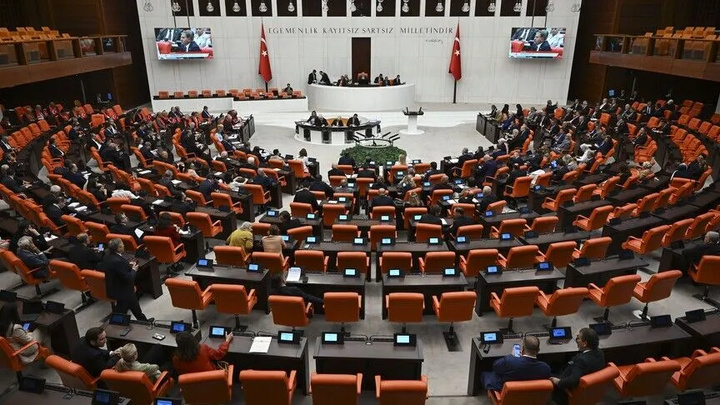
According to Kurdpress, on February 10, 2026, the Foreign Relations Committee of the US House of Representatives held a critical meeting about the US policy towards Syria after the fall of Bashar al-Assad, in which the status of minority rights, the position of the Kurds, and the role of Turkey in the Syrian security equations became the main focus of discussions.
At the beginning of the meeting, Brian Mast, the chairman of the committee, said in a warning tone that the process of transferring power from Bashar al-Assad to Ahmad al-Shara was not without challenges from the beginning, but according to him, "sectarian incidents against religious and ethnic minorities have been excessive."
He pointed to the presence of "foreign fighters in the security structures, many of whom are supported by Turkey", and called the recent actions against the "Syrian Democratic Forces" (SDF), which he called a long-time ally of the United States in the fight against ISIS, "unacceptable."
Referring to Damascus joining the global coalition against ISIS, he described this action as "a glimmer of hope", but emphasized that Syria is still "a long way" from the standards expected by Washington, and some actions of the new government were a "step backwards."
In this meeting titled "Syria at a Crossroads: The Challenges of US Policy in the Post-Assad Era", four senior experts presented different views. James Jeffrey, the former US ambassador and special representative in the anti-ISIS coalition, and Mara Carlin, the former deputy minister of defense, emphasized the continued conditional engagement with the new Syrian government. Geoffrey considered the stability of Syria "necessary" for the peace of the region and called for international coordination. Carlin suggested reopening the American embassy in Damascus and starting plans to reform the security sector.
On the other hand, Nadine Mainza, the former head of the American Commission on International Religious Freedom, warned against what she called "systematic violence against religious and ethnic minorities". He said that in the absence of a correct American policy, there is a risk of "genocide in the next four years" and pointed to the documented cases of the killing of Alevis, Druzes, Yazidis and Christians.
Scott Perry, a Republican representative, harshly questioned the performance of Ahmad al-Shara and said that the issue is not his "inability" to support minorities, but his "reluctance". Referring to the background of Sharia in Tahrir al-Sham, he considered this group to be a reproduction of al-Qaeda and expressed concern about the continuation of jihadist ideology in Syria. During the meeting, Pari played a video of the execution of several Kurdish women by Damascus-affiliated forces, which affected the atmosphere of the meeting.
In response, Mainza defended the self-governing model in northeastern Syria and considered military operations against this region "unnecessary". He emphasized that the narratives that equate the entire region with the PKK are false, and all actors in northeastern Syria cannot be included in a single security framework.
In the final part, each of the experts made suggestions. Mainza called for Syria to be included in the list of "countries of special concern", to establish a monitoring mechanism for the SDF integration agreement with Damascus, and to approve the "Salvation of the Kurds" plan. Carlin emphasized security reforms and continued diplomatic engagement.
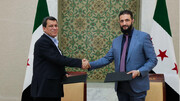
In the conclusion, the chairman of the committee stated that the US support is not a "blank check" for Damascus and that the recent actions against the Druze, Kurds and Alevis have not been confidence-building. Referring to the repeated agreements between Damascus and Mazloum Abdi, the commander of the SDF, he said that Washington will use "practical action, not repeated promises" as the evaluation criterion.
This meeting showed that the American policy towards Syria is at a critical stage, where the balance between interaction with the new government and the pressure to guarantee the rights of minorities, especially the Kurds, has become a decisive test for the future of stability in Syria."
Your Comment