

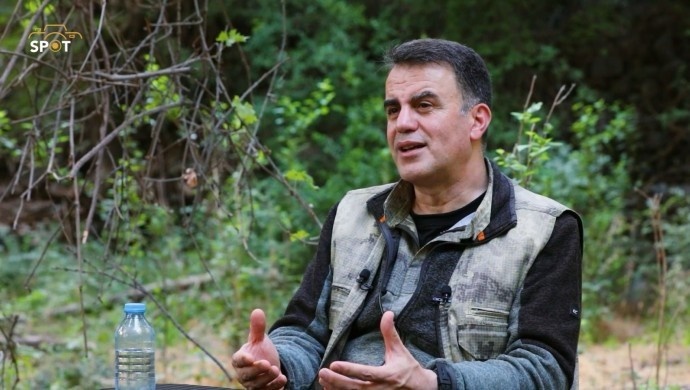
According to KurdPress, Nurettin Demirtaş, a member of the Culture and Arts Movement Committee of the Kurdistan Workers' Party (TEV-ÇAND), spoke about the peace process and democratic society, the draft "Framework Law", the end of the armed struggle strategy, the goals of the new stage and the situation of his imprisoned brother Selahattin Demirtaş in an interview with Erfan Aktan from the SPAT Media Cooperative.Assessing the expected law for this process, he said that its text has not yet been published and that it is not possible to comment on it based on the current discussions and speculations: "There is a law under discussion whose content we do not know. We cannot say anything without seeing the text of the law."
At the same time, Demirtaş emphasized that the PKK will continue its democratic struggle in any situation, regardless of the final form of this law. According to him, the armed struggle strategy has definitely ended and in the new period, democratic politics will be the basis of activities.
We are determined to continue politics within a legal framework
Nuruddin Demirtaş said that the democratic struggle cannot be defined based on the position and fate of individuals, because this struggle is based on social organization and collective activity. He added: "We are an organized force both as a society and as a movement.The struggle for democracy is not a struggle that can be defined based on the situation of each individual. At the same time as the armed struggle strategy is definitively ended, we are fighting for the continuation of democratic politics within a legal and legal framework. We are determined in this regard and this goal will be achieved today or tomorrow.”
Referring to the difficulties of the ongoing peace process, Demirtaş said that the experience of this period has shown that the struggle for peace can be even more difficult than war. He said: “We knew that this would not be easy. Our people are facing both the issue of peace and the issue of freedom. Is there a more beautiful ideal than this? Why should we not adhere to such an ideal?”
He also expressed confidence that this process will come to fruition, adding: “I personally believe that this process will succeed. As a movement, we also believe in its success.If we did not believe in the success of this process, why should we have participated in it?”
Not forming a state; an ideological and strategic choice
A member of the Culture and Arts Movement Committee, in response to the question of why the PKK did not aim to form an independent state, said that this decision did not stem from a lack of power or strength, but rather an ideological and strategic choice.
Referring to Abdullah Öcalan’s view, Demirtaş said: “Öcalan says that even if we have the power to defeat the whole world, we will not do so. Therefore, it is not a question of power; it is a question of thinking correctly, analyzing correctly and choosing the right strategy.”
He added that this view is based on the fact that the state cannot be easily considered compatible with society and freedom: “The state is always a coercive structure in relation to society and is an obstacle to freedom.»
Demirtaş stated that the nation-state model paves the way for new conflicts, citing the 2017 Kurdistan Region independence referendum as a practical example of the consequences of this approach.
“The reality of the world and the Middle East shows that the establishment of a new nation-state will lead to more conflicts. Wherever there is a nation-state, there is also the potential for conflict. There is no example of a nation-state that is truly free and independent in the world. The nation-state system has become the greatest tool of capitalism.”
Our goal is a thousand times more difficult than establishing a state
Nuruddin Demirtaş described the main goal of the PKK as a movement as expanding social organization and raising the level of awareness and freedom of society.He said: “Our claim is to increase our level of freedom in terms of consciousness and culture, along with the organization of society, and to present this model to the entire Middle East and all of humanity. This is a more valuable goal than having a state, and its realization will be a thousand times more difficult than establishing a state.”
Demirtaş also said that the decision to transition from armed struggle to democratic struggle was not a sudden decision and was based on the experience and achievements of the past few decades: “At the stage we have reached now, the achievements of 50 years of struggle and the level of awareness and organization of society made it necessary to end the armed struggle and establish a democratic struggle.”
According to Demirtaş, this change of strategy does not mean getting rid of a burden or reducing responsibilities: “On the contrary, this decision means accepting new responsibilities. Our burden has not become lighter, but heavier.»
This process began 35 years ago
Nuruddin Demirtaş, stating that the current peace process is not a new event and that its history goes back decades, said: “In fact, this process began 35 years ago. Öcalan had clearly stated these issues in his conversation with Mehmet Ali Birand. He had also said during the 1993 ceasefire that he was looking for an interlocutor for peace; but such an interlocutor has not been found to this day.”
Demirtaş: There is no tension between Selahattin Demirtaş and the PKK
Nuruddin Demirtaş answered a question about Selahattin Demirtaş, the former co-chair of the Peoples’ Democratic Party (HDP), in another part of the interview. He described Selahattin Demirtaş’s imprisonment as “unfair” and considered its prolongation unacceptable.
Demirtaş added: “This detention was unfair, it has lasted for a long time and it is still continuing.We believe that if he were free, he could have had a greater contribution and role in the peace process.”
He also rejected reports and perceptions that suggest there is a rift between Selahattin Demirtaş and the PKK, saying: “Creating the impression that there is tension and rift between him and the PKK is not entirely correct. Such an issue is not at all relevant.”





Your Comment