

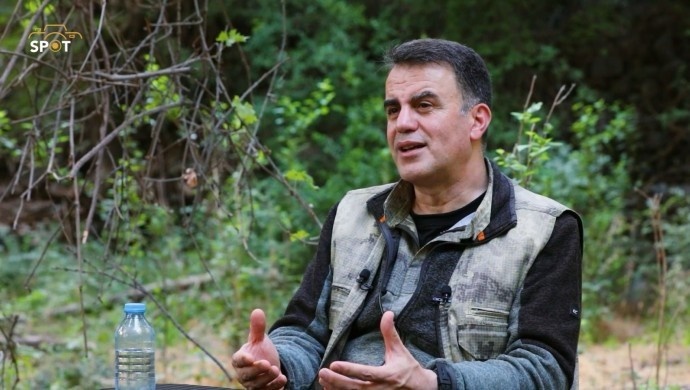
According to KurdPress, "Ghareb Hasso", the co-chair of the Democratic Union Party (PYD), emphasizing that the integration process between the autonomous administration in northern and eastern Syria and the interim government in Damascus is facing serious challenges, announced that accepting the achievements of women, recognizing the Kurdish language and the status of the Women's Protection Units (YPJ) are among the basic conditions for the success of this process.He also warned about the developments on the Lebanese border, saying that they had received information about “movements and interventions on the Lebanese border” that had not yet been made public.
“Gharib Hasso,” the co-chair of the PYD, spoke to the “Walat” agency about the latest status of the integration process between the autonomous administration and the Syrian interim government, issues related to the rights of the Kurds, the return of refugees, and regional developments.
Referring to the continuation of negotiations between the autonomous administration and the Damascus government after the January 30 agreement, Hasso said that the integration process is still ongoing, but faces political obstacles and fundamental differences.
He stated: “We are trying to complete this process as soon as possible, because the situation in Syria is complicated. Syria is still facing a crisis of division and instability, and the current government in Damascus is also facing serious weaknesses."
According to him, about 80 percent of the integration process has progressed, but the remaining 20 percent includes fundamental issues such as women's rights, the Kurdish language, changing the names of Kurdish regions, and the status of universities, which have become more difficult to resolve.
Hasso claimed that the Damascus government has an approach similar to the policies of the former Baath government in accepting these issues, and said: "The issues that remain are the main issues. The Damascus government does not accept the Kurdish language, women's rights, and some of the achievements of the Kurdish regions."
Turkey's role in the integration process
The PYD co-chair, referring to Turkey's role in the negotiations between Damascus and the autonomous administration, said: "The problem of not accepting the Kurdish language is not only related to the Damascus government, but Turkey also has a role in this issue. If Turkey recognizes the rights of the Kurds, Syria will also be affected.He added that Ankara is trying to gain a greater place in the future structures of Syria, describing this issue as “dangerous.”
Hassu also considered the renaming of Kurdish villages and cities as part of policies that he said were being pursued under Turkish pressure, stressing: “Kurdish names must remain Kurdish and the characteristics of Kurdish areas must be accepted.”
Acceptance of the YPJ and the Kurdish language; a condition for the continuation of the integration process
Regarding the role of women and the Kurdish language in the negotiations with Damascus, Gharib Haassu said: “Women’s achievements are a fundamental issue. All of our people and other Syrian societies want the recognition of the YPJ and the preservation of women’s achievements.”
He claimed that opposition to the role of women stems from the “mentality of groups close to Hayat Tahrir al-Sham,” adding: “If there is no recognition on the issue of women, the integration process will not proceed."
He also said about the Kurdish language: "If the Kurdish language is not made official and is not taught in schools, how can we talk about integration? This process is a strategic and long-term issue for us, not a tactical move."
Hassu warned: "If the achievements of women and the Kurdish language are not accepted, we cannot continue this process either."
Warning about developments in Lebanon and the possibility of regional conflict
In another part of his speech about the possibility of the conflict spreading in Lebanon, the PYD co-chair said that the recent NATO summit and meetings between Syrian, Turkish and American officials could affect developments in the region.
He stated: "If a war breaks out in Lebanon, it will be very dangerous for Syria. The Syrian situation is not ready to enter such a war, because there is no unified army and various armed groups are present in the country."
Hessu added: "Based on the information we have received, there are movements from the Homs region towards Tripoli, Lebanon. We do not know what preparations are being made in Tripoli, but according to our information, there is an intervention there that has not yet been reported to the media."
He also said that Hezbollah in Lebanon has also made statements about the border situation between Syria and Lebanon and that there is a possibility of a large-scale conflict.
Return of refugees from Afrin and Sarkheni
Gharib Hessu stated regarding the return of refugees from the Afrin and Sarkheni regions that after the recent agreements, the process of returning some refugees has begun.
He said: "The refugees from Afrin have returned and it is expected that about 500 displaced families from Sarkheni will also return to their areas in the coming days."
However, he emphasized that the security of the returnees has not yet been guaranteed.Hassou claimed: “Citizens who have returned to Afrin are facing security problems, pressure and violations of their rights. The Damascus government has not taken responsibility for ensuring their security.”
He also said about the situation of the displaced’s properties that some returnees are facing difficulties in reclaiming their lands and houses.
Turkish military presence in Syrian territory
The PYD co-chair continued by saying about the presence of Turkish military bases in northern Syria that according to the January 30 agreement, Turkey must withdraw from Syrian territory, but it still has bases in areas such as Afrin and Sarkhani.
He said: “Turkey has established military bases in various countries in the region, including Syria and Iraq. This military presence increases tensions and instability.»
Hesu accused Turkey of supporting armed groups in northern Syria, saying: “Citizens are being killed and kidnapped in Afrin, and the groups that have established their bases in this region are responsible for these actions.”
He concluded by emphasizing that for the integration process to succeed, women’s rights, the Kurdish language, and the characteristics of the Kurdish regions of Syria must be recognized, saying: “We are determined to bring this process to a conclusion, but this is only possible by accepting the achievements of the people of the region.”
Your Comment