

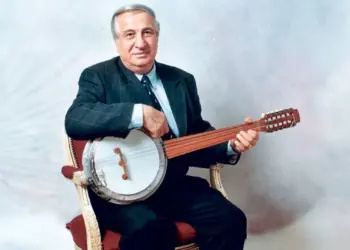
According to KurdPress, 17 years have passed since the death of the immortal artist Aram Tigran; an artist who produced 14 albums during his life. Aram Tigran is known as the "Dove of Peace" among the Kurdish and Armenian people and has sung in the languages of both nations. The Tigran family was saved by a Kurdish family during the Armenian Genocide in 1915.The Tigran family settled in the village of Bandeh, in the Sassoon district of Batman province, and continued to live there for a while. After a while, the family migrated to the city of Qamishlo in Syrian Kurdistan. Aram Tigran was born in Qamishlo in 1934. Aram Tigran began playing the oud at the age of 9 and gradually progressed in his art. Aram, who had gained a special place in the hearts of the Kurdish and Armenian people, migrated to Yerevan, the capital of Armenia, in 1966 and worked on Yerevan Radio for 18 years. Aram Tigran, who is known for his jumbush (movement) instrument, later made this famous statement in a program: “If I were to be born again, no matter how many tanks, guns, and weapons there are, I would melt them all down and make tambourines, jumbushes, and sornas out of them.»
After finishing his career at Radio Yerevan, Aram Tigran immigrated to Athens, the capital of Greece, in 1995 and settled there. During his 75-year life, he sang 230 Kurdish songs, 150 Arabic songs, 10 Syriac songs and 8 Greek songs. He also sang in Turkish, Syriac and Kurdish with the Kurmanji dialect. Aram Tigran went to Amed (Diyarbakir) on Nowruz 2009. His physical condition deteriorated and he underwent angiography. On August 6, 2009, while Aram Tigran was being treated in a hospital in Greece, his condition deteriorated and he died on August 8. Aram Tigran's will was that Amed be buried; but his request was rejected on the grounds that he was "not a Turkish citizen". For this reason, Aram Tigran's body was buried in Brussels. Some soil was taken from Amed and sprinkled on Aram Tigran's grave.Play
Neshat Gochman, the instructor of the Mesopotamian Music Center, has been active in the field of Kurdish music for nearly 40 years. Since his time at the Mesopotamian Cultural Center, he has continued this activity and has been preserving the legacy of Aram Tigran. In an interview with the Kurdish news agency, Neshat Gochman spoke about the eternal artist Aram Tigran and his legacy.
Referring to the richness of Aram Tigran's art, Neshat Gochman said: "His art cannot be described with words and sentences. I can say that Aram Tigran left behind a very strong and very rich legacy. I have been teaching his songs to my students for nearly 40 years and we have put all of Aram Tigran's songs into music; this is a source of pride. He has left us a very beautiful legacy.Master Aram Tigran is very important to us; he built a bridge between Armenian and Kurdish music. Truly, each of Master Aram’s songs is like a classic. For years, Aram Tigran’s songs have been sung among Kurds.”
He was a very humble artist
Neshat Gochman continued his speech with these words: “My father listened to Master Aram’s songs, and I met Master Aram Tigran through my father. Later, the master came to give a concert. When he came here, we got to know each other. He was truly a very humble artist; he had composed thousands of songs and in our eyes, he was very powerful and very rich, but he came to sit next to us, took off his jacket and sang a song for us. He was such a natural and unpretentious person. I am truly very happy that Master Aram worked so hard and worked so hard for Kurdish music.»
It was a golden memory for us
Nashat Gochman continued his speech by expressing his shared memories with Aram Tigran: “When we were sitting next to each other at the institute, I told him: “Master, I have been teaching your songs to my students for years and singing your songs in programs.” He also said: “I am honored that there are artists like you and masters like you who will sing my songs again in the future.” Master Aram was not just a singer. He expressed the pain and suffering of the Kurdish people with his songs, voice and music and expressed himself very beautifully. One of his special features was that he spoke Kurmanji very well. Dozens of our young people improved their language with his songs. This was also another dimension of him. I am very happy and proud that Master Aram worked so hard for our culture.»
Tigran Aram’s message was for all children
Referring to Tigran Aram’s will and his words: “If I were to be born again, I would melt all the tanks, guns, and weapons and make tambourines, jumbushs, and serenas out of them,” Neshat Gochman concluded his speech with these words: “This statement by Master Aram is very meaningful. I also think like him and say, let’s teach songs to children all over the country and teach them the language. Let all children grow up with art; this art can be Kurdish music, theater, painting, or dance. Every Kurd should have a connection with art. Then their future will be broader. We remember Master Aram with respect.”




Your Comment