
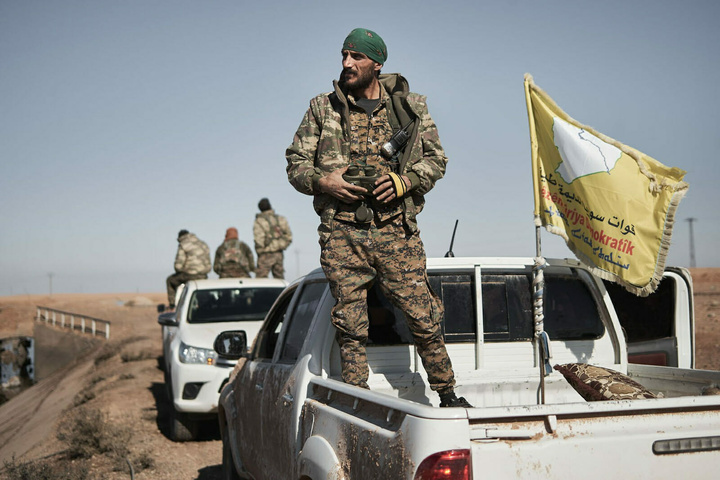
According to KurdPress, according to AFP, Mutlu Ceviroglu, a Washington-based analyst and expert on Kurdish issues, in response to the announcement of the end of the process of integrating the Syrian Democratic Forces and the security and administrative institutions of the Kurdish regions into the structure of the Damascus government, considered this development a "bitter end" for a force that had played a pivotal role in the war against ISIS for years. At the same time, Mazloum Abdi, commander of the Syrian Democratic Forces, announced that the phase of integrating the Kurdish military, security and administrative institutions into the structure of the Syrian government has ended.Mazlum Abdi announced on Thursday at a ceremony in Qamishlo, northeastern Syria, that the integration of the military, security and administrative institutions into the national institutions of the Syrian government is “complete and finished.”
“From now on, we are entering a new phase,” he said, adding that the Kurds’ struggle to secure the rights of their people in the Syrian constitution would continue.
The development comes after months of negotiations between Syrian Kurdish representatives and the Damascus government, and within the framework of an agreement signed in January between Abdi and Syrian President Ahmed al-Sharaa. According to the agreement, the civilian and military institutions of the Kurdish-controlled autonomous administration were to be fully integrated into Syrian government structures.The implementation of the agreement began after clashes between Kurdish forces and the forces of the new Syrian government, which led to the loss of parts of the areas previously under Kurdish control.
During the implementation of the agreement, Syrian government forces entered the cities of Hasakah and Qamishlo, and the management of Qamishlo airport and a number of important oil fields was also transferred to Damascus.
The Syrian government also took steps to recognize the rights of the Kurds. On January 16, Ahmed al-Shara issued a decree recognizing the national rights of the Kurds and adopting Kurdish as a national language in Syria, a move that had not been seen since Syria’s independence in 1946.
In February, Nureddin Ahmed Issa, a resident of Qamishlo, was appointed governor of Hasakah, and in March, Seypan Hamo, a senior Kurdish military commander, was appointed regional deputy minister of defense.However, the details of how the SDF and the Kurdish security forces will be integrated into the Damascus government’s military and security structure have not yet been fully disclosed.
Mutlu Çiviraoğlu, a Washington-based analyst and expert on Kurdish issues, called the development the end of one of the most important political and military experiences of the Syrian Kurds.
“The dissolution of the SDF means a bitter end,” he told AFP.
“A military force that was very successful, defeated ISIS many times and was widely admired, is unfortunately coming to an end,” Çiviraoğlu added.
The SDF, formed in 2015 with US support and initiative, became Washington’s main partner in the fight against ISIS in Syria. The force was a mix of Kurds and Arabs and, according to Mazloum Abdi, at one point numbered around 100,000.The Syrian Democratic Forces (SDF) took Kobani from ISIS after four months of fierce fighting and played a key role in the group’s territorial defeat in Syria in the following years.
However, after the fall of Bashar al-Assad’s regime in 2024 and the establishment of a new government in Damascus, the US approach to the Syrian Kurdish forces changed. Washington gradually reduced its support for the Kurdish autonomous structure and supported the new Syrian government.
At the same time, the SDF’s control over the Arab regions of Raqqa and Deir ez-Zor was lost, and according to Fabrice Balanche, a researcher on Syria, a large number of its Arab forces defected; as a result, the strength of the military force under Abdi’s command was reduced to about half of its previous capacity.
The integration of Kurdish structures into the Syrian government has taken place in a situation where the country’s Kurds have faced extensive restrictions for decades.At various times, Kurdish language teaching, Kurdish ceremonies and celebrations, and some of their cultural manifestations were restricted.
Also, after the 1962 census, about 20 percent of Syrian Kurds lost their citizenship; an issue that is considered one of the most important factors of the historical dissatisfaction of the Syrian Kurdish community.
Damascus has now granted more privileges to the Kurds compared to previous governments, but the end of the Kurdish-led military and self-governing structure means the abandonment of the autonomy model that had been formed in northern and northeastern Syria for more than a decade.Abdi, accepting the entry into a new phase, has also emphasized that efforts to consolidate the rights of the Kurds in the Syrian constitution will continue; an issue that indicates that after the end of the military and administrative phase, the focus of Syrian Kurdish political forces will likely be on achieving legal and political guarantees within the framework of the central Syrian government.
Your Comment