

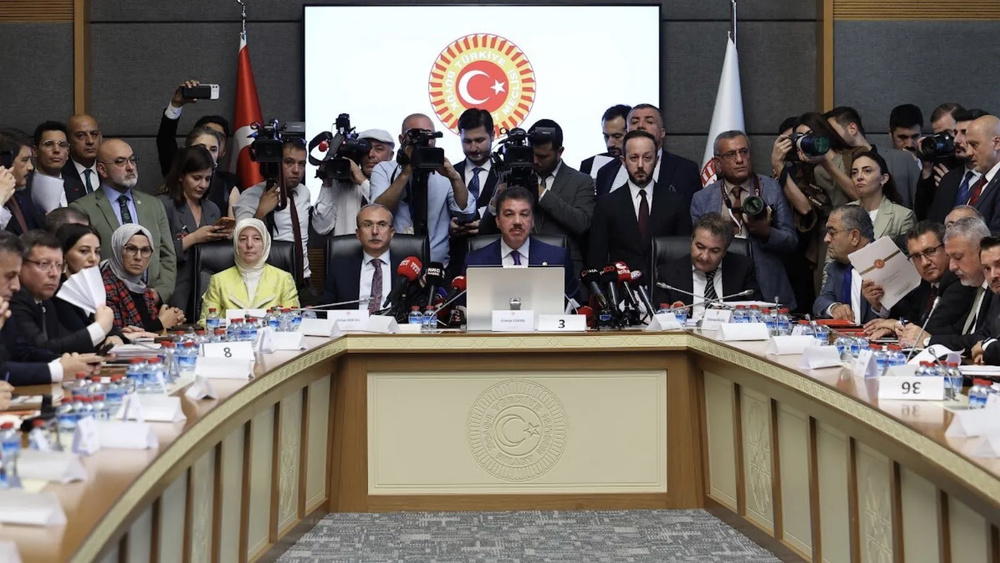
According to Kurdistan Press, the review of the general and articles of the proposal called the "Framework Law" was completed after 18 hours of negotiations in the Justice Committee of the Grand National Assembly of Turkey, and the proposed text was approved with the positive votes of representatives of the AKP, the Nationalist Movement Party (MHP), the Dem Party and the New Party.The proposal, officially titled the “Law on Strengthening National Solidarity and Social Integration,” would regulate the legal framework for the dissolution and disarmament of the PKK and the return of its members. The suspension of investigations, trials and the execution of judicial decisions would only be possible after the end of the practical existence of the PKK and its affiliated groups has been confirmed.
According to the text approved by the commission, Turkey’s security agencies must first examine and approve the dissolution of the PKK and the handover of all weapons, ammunition and equipment under its control. After that, the Turkish National Security Council must issue a decision approving this situation and this decision must be published in the official gazette.
Five- or 10-year suspension of cases and penalties
The law covers crimes such as membership in the organization, knowingly and intentionally aiding, promoting the organization, crimes committed within the framework of its activities and financing.In cases where the maximum penalty is 15 years of imprisonment or less, investigations and trials will be postponed for five years. In crimes where the penalty is more than 15 years of imprisonment, life imprisonment or aggravated life imprisonment, the suspension period will be 10 years.
In the context of sentence execution, convicts whose total sentence is 15 years or less will be suspended for five years, and convicts with more than 15 years of imprisonment, life imprisonment or aggravated life imprisonment will be suspended for 10 years. The decision on the suspension of sentence execution will be issued by the judge executing sentences.
During the suspension period, the judicial and criminal statute of limitations will not be calculated, and the documents and evidence in the files will be kept until the end of this period.
If the person subject to the law commits a terrorism-related crime during the suspension period, the suspension decision will be canceled and the investigation, trial or execution of his sentence will be resumed.On the other hand, if this period passes without committing a new crime, a ban on prosecution or a lawsuit will be issued in his case and the determined punishment will be considered executed.
Who are exempted from the law?
People who have been convicted of premeditated murder within the framework of the organization’s activities will not benefit from this law. Also, crimes committed before June 1, 2005 and punishable by life imprisonment or aggravated life imprisonment are excluded from the suspension provisions.
These exceptions prevent a number of prisoners and former PKK members from using the law.
People subject to the provisions must also submit their written request to the prosecutor’s office in their area or to the institutions designated by the Executive Board within a maximum of six months after the publication of the National Security Council’s decision.Fate of temporary detention and appeal cases
In cases subject to suspension, precautionary measures such as temporary detention and judicial supervision will be reviewed again by the competent judge or court and may be canceled if legal conditions exist.
Cases that are in the appeal or review stage will be overturned and returned to the relevant judicial authority to decide on the application of the suspension provisions.
Individuals who have the right to object can object to the decision of the prosecutor or court on suspension within two weeks.
In the case of properties and assets subject to confiscation, a liquidation order will be issued at the same time as the suspension decision is issued and they will be transferred to the state treasury.
Formation of a high-level board chaired by Vice President Erdoğan
A board chaired by the Vice President of Turkey will be formed to guide, coordinate and evaluate the implementation of the law.The ministers of justice, foreign affairs, interior and defense, the secretary general of the presidency, the head of the Turkish National Intelligence Organization and the secretary general of the National Security Council will be members of this board.
This board can form sub-committees if necessary and invite representatives of ministries, state institutions and necessary individuals to its meetings. It is also envisaged that individuals can be assigned to sub-committees to advance the process related to the PKK.
After examining the periodic reports on the complete dissolution of the organization and the law enforcement process, the said board can request judicial, administrative measures or new legal reforms.
The suspension of cases and sentences will also be periodically evaluated under the supervision of this board. If necessary, this body can request the courts to remove legal deprivations resulting from investigations, trials or convictions.In five-year suspensions, the request for the lifting of legal disqualifications will be submitted after two years and in 10-year suspensions, after three years.
Monitoring Commission to be established in Parliament
According to the proposal, the Executive Board is required to regularly inform the Grand National Assembly of Turkey about the activities and progress of the process.
The Presidency of the Parliament will also establish a commission called the “Monitoring Commission”. This commission is responsible for following up on the implementation of the law and the stages of the process and providing advisory proposals.
The Secretariat of the Executive Board will also be the responsibility of the Secretariat General of the Presidency of Türkiye.


Your Comment