
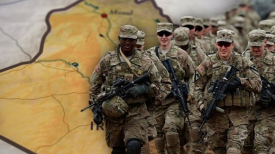
According to Kordpress, the 2027 defense budget bill of the United States to deal with ISIS indicates a significant change in Washington's security strategy in the Middle East, in which non-governmental forces, especially Kurdish actors, are marginalized and the focus is increasingly placed on strengthening official government institutions
Based on this request, direct US aid to the Peshmerga forces of the Iraqi Kurdistan Region has been completely cut off, and the name "Syrian Democratic Forces" (SDF) has been removed from the list of Washington's field partners in Syria for the first time. These developments show that America is moving away from its previous reliance on Kurdish forces on the battlefield against ISIS and moving towards cooperation with central governments in the region.
In the framework of the defense budget proposed by Donald Trump, the US President, total defense spending has reached an unprecedented figure of 1.5 trillion dollars. In the meantime, 303 million dollars have been allocated to the "training and equipping fund to fight ISIS". Since 2017, this fund has been used as the Pentagon's main tool to support local forces in Iraq and Syria.
This figure has decreased significantly compared to the peak years of the battle with ISIS. For example, in 2017 and 2018, more than 1.5 billion dollars were allocated to this fund. This amount gradually decreased in the following years and has now reached its lowest level. In the 2027 budget distribution, the share of Syria is 130 million dollars, Iraq is 119 million dollars, Lebanon is 36 million dollars and Jordan is 18 million dollars. However, the way these resources are allocated reflects a change in America's priorities.
In Iraq, the allocated budget has been almost halved compared to last year, and more importantly, these resources will be distributed directly through the central government in Baghdad. The Peshmerga Ministry of the Kurdistan Region, which received part of these aids in recent years, not only does not have a share in the new budget, but it is not even mentioned as an American partner.
This is despite the fact that American financial aid to the Peshmerga had an increasing trend in recent years; So that the budget for training and equipping these forces increased from 4.9 million dollars in 2024 to more than 60 million dollars in 2025 and 2026. However, in 2027, this figure has decreased to zero.
Also, the direct payment of the Peshmerga forces' salaries by the United States, which amounted to 135 million dollars in 2024, has been completely stopped since 2026, and the responsibility has been handed over to the Iraqi government. This action was taken in the framework of an agreement between Washington and Baghdad in 2022.
In contrast, the forces that will receive US support in 2027 include the Iraqi Ministry of Defense and the Counter-Terrorism Service, which operates directly under the Iraqi Prime Minister.
A similar change is observed in Syria. While the 2026 budget explicitly identified the SDF as a US-backed partner, the 2027 version only mentions "approved groups and individuals" without naming them.
This ambiguity arises in the context that after the ceasefire agreement and the process of integrating the Syrian Democratic Forces into the structure of the Syrian Army, the position of these forces as an independent actor has been weakened. However, the new budget does not even mention the name of the Syrian army, and it is not clear which forces will benefit from these resources.
At the same time, the United States still plans to continue operations against ISIS in Syria. Among other things, support in the management of ISIS-affiliated prisoners and dealing with the remaining nuclei of this group. The amount of the budget in this sector has not changed compared to the previous year, but the Pentagon emphasized that it is possible to revise it depending on the developments in the field.
Another noteworthy point in the new budget is the expansion of the geographical scope of the anti-ISIS mission. For the first time, Jordan is included in this framework and the special forces of this country will receive 18 million dollars in aid. Also, the aid to the Lebanese army continued for the second year in a row and its amount has more than doubled.
The Pentagon stated the reason for this action is the concern of ISIS activities on Syria's borders with Lebanon and Jordan, but analysts believe that these changes are part of the broader US strategy to strengthen regional governments and curb the influence of non-state actors.
Overall, the redesign of the Training and Equipping Fund shows that the United States is redefining its security network in the Middle East, in which the role of Kurdish non-governmental forces is reduced and cooperation with central governments is prioritized. This development can have significant consequences for the future of the Kurds' role in the security equation of the region as well as the process of confronting ISIS.


Your Comment