

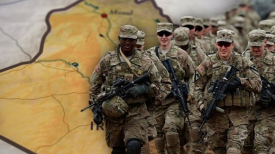
According to Kurdpress, the reduction of US military aid to the Peshmerga forces of the Kurdistan Region in the 2027 defense budget bill of the United States has provoked extensive discussions about the future of security relations between Washington and Erbil; Especially in the situation that the Kurdistan Region is still considered one of the most important partners of the United States in the fight against ISIS and maintaining the stability of northern Iraq.
On April 3, 2026, the US Department of Defense published the details of the budget for the "training and equipping against ISIS" program for Iraq; A budget in which direct aid to the Ministry of Peshmerga of the Kurdistan Region has been reduced from 61 million dollars to zero. Aid related to the payment of salaries of Peshmerga forces also decreased from 60 million dollars to zero last year. However, Washington has still earmarked more than $1.35 million in medical aid for the Peshmerga forces and emphasized that this support will continue for the continuation of anti-ISIS operations and the training of the forces.
This budget reduction caused the formation of speculations in social networks; including the claim that the administration of Donald Trump is "punishing" or that Washington has reduced its support due to the slowness of the process of reforms and integration of the Peshmerga forces. But the American officials and the officials of the Kurdistan region both reject these narratives.
The Ministry of Peshmerga of the Kurdistan Region announced on May 3 that the "suspension of American support" is not true and military cooperation with Washington continues based on the joint memorandum. The ministry explained that the reduction of part of the aid is mostly related to limiting the activities of ISIS and changing the structure of the mission of the international coalition.
In the same framework, the new US budget still includes 1.82 million dollars of equipment for the SWAT special forces in Sulaymaniyah; The forces that, according to the Pentagon, have played an effective role in dealing with ISIS in the north of the Kurdish coordination line in cooperation with the American special forces. Also, in the new budget, 57 million dollars have been allocated for Iraq's counter-terrorism service and 38 million dollars for the Iraqi Ministry of Defense. In total, the budget for the counter-ISIS program in Iraq has decreased from 175 million dollars to about 96 million dollars.
Despite these reductions, some representatives of the US Congress have warned about its consequences. Republican Congressman Mike Turner expressed his concern about the reduction of support for the Peshmerga in a recent meeting of the US Armed Services Committee. On the other hand, Daniel Zimmerman, US Deputy Secretary of Defense for International Security Affairs, emphasized that the Peshmerga is still "one of America's most capable and reliable partners" in the region.
These positions are raised while after the February 28 war between the United States and Israel against Iran, armed groups in Iraq have carried out hundreds of drone and rocket attacks against American bases and diplomatic centers in Erbil and Baghdad; An issue that, according to American officials, has once again highlighted the importance of the Kurdistan region for Washington's security interests.
The gradual end of the agreement between the United States and the Peshmerga
An important part of the decrease in American support is due to the gradual end of the four-year memorandum signed in 2022 between Erbil and Washington to reform and integrate the Peshmerga forces. This memorandum, which has been extended until September 2026, aims to merge the forces affiliated with the Kurdistan Democratic Party known as "Unit 80" and the forces affiliated with the Patriotic Union of Kurdistan known as "Unit 70" under the command of the Ministry of Peshmerga.
Victoria Taylor, a former State Department official, said the end of aid under the MOU "shouldn't come as a surprise" because the Trump administration has cut a large portion of US foreign aid in recent years.
The Pentagon Inspector General's report published in February 2026 also emphasizes that the reduction of support for the Peshmerga is part of the planned process of the international coalition and has nothing to do with the recent war with Iran. At the same time, this report states that the Peshmerga reform process has progressed much slower than expected, and even with a one-year extension, the possibility of its complete completion by 2026 is low.
America's dissatisfaction with the slow integration process
Many analysts and former American officials believe that the main reason for the reduction of Washington's support is the slowness of the process of integration of Kurdistan's party forces into the official structure of the Ministry of Peshmerga.
Yervan Saeed, director of the Center for Kurdish Peace Studies at the American University, says American officials and the international coalition are frustrated by the limited progress of reforms. According to him, Erbil could have a stronger position to extend the memorandum and continue receiving funds if it implemented the coalition's roadmap more seriously.
Kurdistan Regional President Nechirvan Barzani also recently criticized the lack of "sufficient political will" to advance the process of Peshmerga unity at the graduation ceremony of military students in Zakho and warned that this issue has damaged the credibility of the Kurdistan Region in front of Western allies.
The future of Western military cooperation with the climate
According to the 2024 agreement between Baghdad and the international coalition, the coalition forces are supposed to end their mission in Iraq by September 2026. Most of the coalition forces have already left the territory of Iraq and mainly remained in the Kurdistan region.
In the meantime, Peshmerga officials say that efforts are underway to sign new bilateral agreements with the United States and European countries. However, the fate of these collaborations is still unclear.
Bakhtiar Mohammad Sediq, the secretary general of the Peshmerga Ministry, said that Germany and Britain will probably follow Washington in their decisions, but France and Italy may adopt an independent policy towards the region.
In this regard, the Minister of Defense of Italy recently emphasized in a meeting with Nechirvan Barzani in Rome that Rome's support for the Kurdistan region will continue in the military and security field.
Currently, the United States, France, Britain, Germany, Italy and the Netherlands support the Peshmerga reform process in the form of a "multinational advisory group", but it is not yet clear whether these plans will continue after the end of the coalition's mission in 2026.
Despite the budget cuts, many American officials still emphasize the strategic importance of the Kurdistan Region. Miles Coggins, the former spokesman of the anti-ISIS coalition, says that cooperation with the Peshmerga has been "low-cost but very productive" for the United States; Because the Kurdish forces have been able to maintain the security of the region and the presence of the international coalition with a limited budget.
He also called for the immediate sale of anti-drone systems to the Kurdistan Region and warned that recent drone attacks against oil infrastructure and American bases in the region could threaten the security of Western investments in the region.



Your Comment