
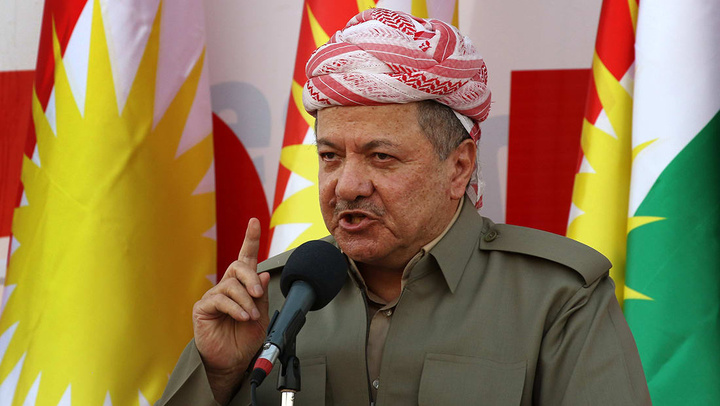
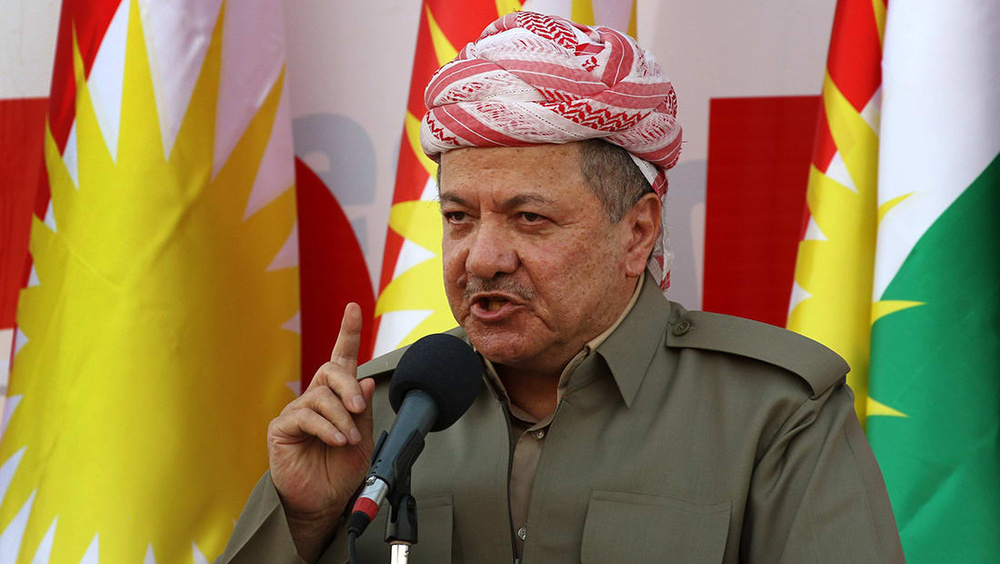
According to Kurdistan Press, Massoud Barzani responded to this wave of political movements and pressures by publishing an official statement on the X social network, rejecting any mechanical approach to the Peshmerga weapons. The text of this message is as follows:
"For some time now, due to the specific political conditions that have arisen, some parties have been talking about the Peshmerga weapons and presenting incorrect analyses and wrong views on this matter. Here, it is necessary for all parties to remember that the Peshmerga is born of the blood, suffering and tears of the Kurdistan nation.
The Peshmerga weapon is not a piece of iron, an arsenal or a tool for fighting. The Peshmerga weapon is its history, sacrifice, dignity and belief. The Peshmerga weapon is the love and commitment that it always has towards its nation, land and homeland."
The KDP leader’s quick and ideological response is not the result of a political vacuum; rather, it is a reflection of a new security macro-trend in Iraq’s geopolitical landscape that challenges the foundations of the Kurdistan Region’s military autonomy.
The initial spark of this new blockage was ignited when influential currents among the Shiite armed groups began to take sustained practical steps towards convergence with the federal government. In this regard, senior leaders of the Asaib Ahl al-Haq and Imam Ali Brigades movements, in a strategic meeting with Iraqi Prime Minister Ali Falih al-Zaidi, officially announced their readiness to hand over heavy and semi-heavy weapons to the central government and to obey the orders of the Supreme Command of the Iraqi Armed Forces.
This action called into question the legitimacy of maintaining parallel military structures in the Kurdistan Region; especially since Bafel Talabani, the head of the Patriotic Union of Kurdistan and Barzani’s traditional rival, immediately and openly welcomed this move by Baghdad; a step that Erbil interpreted as a green light from Sulaymaniyah to Baghdad to put pressure on the region’s military structure.
The international dimensions of this crisis have entered a more serious phase with the recent statements of Tom Barak, the US special representative for Iraq and Syria. Barak, explaining the new US surveillance doctrine, explicitly stated that Washington considers capitals and central governments to be its official and legal counterparties within the framework of national sovereignty.
This diplomatic signal made it clear that the Western umbrella of support would no longer guarantee the survival of independent weapons structures in Erbil as it had before. Experts believe that with this approach from Washington and the convergence of Baghdad, the possibility that the disarmament and arms monopoly law will also include the Peshmerga forces of the Kurdistan Region is very high; an option that the Democratic Party considers its infallible red line.
The US-led international coalition against ISIS has been pursuing a comprehensive, multi-phased plan for years to organize, modernize, and integrate the Peshmerga forces (merging the 80th Division of the Democratic Party and the 70th Division of the Patriotic Union under the supervision of the Ministry of Peshmerga). However, the coalition has repeatedly warned that deep internal divisions and deep-rooted distrust between the KDP and the Patriotic Union are the main obstacles to achieving these structural reforms.
Now, the long-standing inaction of the Erbil-Sulaymaniyah bipolar in integrating its forces has become a lever in the hands of the central Iraqi government to extend its military sovereignty to the northern borders of the country, relying on international law and implicit regional support.
Massoud Barzani's statement shows that Erbil defines the mission of the Peshmerga forces beyond a classic military structure and as a symbol of the sovereign identity of Kurdistan. At a time when Baghdad is rebuilding its central authority, the Democratic Party's insistence on maintaining the Peshmerga's military independence and, in contrast, the Patriotic Union's readiness to be flexible towards Baghdad could confront the Kurdistan Region with one of its greatest structural challenges in the past two decades.



Your Comment