

According to KurdPress, National Context claimed that as the peace process between Turkey and the Kurdistan Workers' Party (PKK) enters a new phase and the process of disarmament and evacuation of the group's bases along the Turkish border begins, published evidence and reports show that the PKK is strengthening and rearranging its military presence in the eastern Kurdistan Region of Iraq, which could change the group's deployment plan after four decades.
According to recent reports, the PKK is building new tunnels in the Halabja region.The area has witnessed armed activity in recent months and, if confirmed, would be the latest in a gradual shift of the PKK’s military infrastructure to the eastern Kurdistan Region.
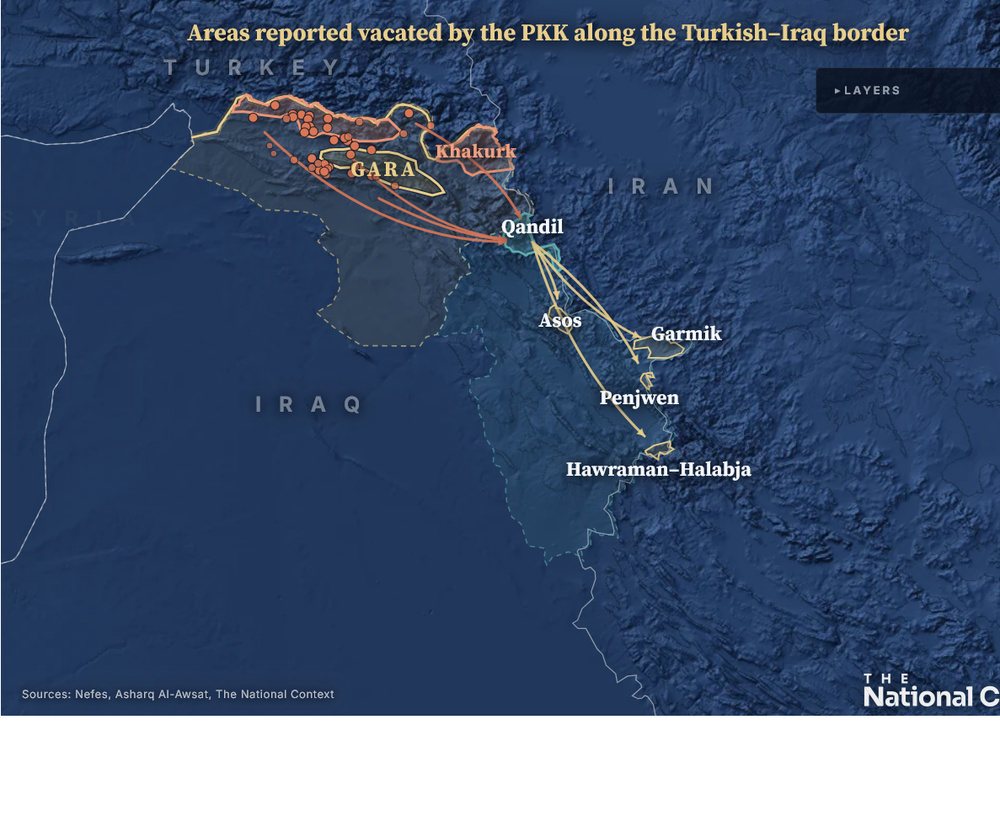
This shift has been taking place in stages over more than a decade. From its traditional base in the Qandil Mountains, the PKK has expanded its presence to the Qaladze, Asos, Maut, Panjvin and now Halabja regions. The continuous mountain range between Qandil and Halabja also allows for the movement of forces without the need for permanent deployment along the entire route.
In the 1980s, almost all of the PKK’s bases were located along the Iraq-Turkey border, from Haftanin and Amadey to Khakurk, Gara and Qandil. However, the expansion of Turkey’s permanent military presence in northern Iraq and the establishment of dozens of military bases gradually pushed the group south and east of the Kurdistan Region.According to the report, since 2012, as Lahore Sheikh Jangi’s influence in the PUK security structure increased, the party’s relations with the PKK have reached a level close to strategic cooperation, paving the way for the PKK to expand its presence in areas under the PUK’s influence.
Negotiations focus on the Turkish border
According to reports, as part of the peace process, the PKK must evacuate its positions along the Turkish border. Many of these areas are now under the control of the Turkish army, and the remaining bases are expected to be handed over as the peace process continues.
In contrast, there has been no sign of Ankara demanding the PKK withdraw from areas such as Asos, Maut, Panjwin, or Halabja. National Context sees this as a sign that Turkey’s priority is to secure its borders and establish a military presence in the border strip, rather than completely eliminating the PKK from Iraq.Convergence with the Patriotic Union
The analysis also points to improved relations between Turkey and the Patriotic Union of Kurdistan, while the latter’s close ties with the PKK continue. Recent meetings between security and political officials from both sides, including talks with Bafel Talabani and Qobad Talabani, indicate that the channels of communication between Ankara and the Patriotic Union have become more active than before.
The geopolitical realignment of the PKK
The analysis concludes that if the peace process is successful, the PKK will not simply transform from an armed organization into a political party in Turkey, but will continue to maintain its position as a regional actor by maintaining its infrastructure in the eastern Kurdistan Region.
Accordingly, the peace process may not be the end of the PKK’s military and regional role, but rather the beginning of a geopolitical realignment of the group, in which the PKK’s military center of gravity will shift to theIt is being transported from the Turkish borders to the eastern Kurdistan Region.



Your Comment