

According to Kurdpress, at the same time as the progress of the peace process between Turkey and the PKK, the integration of the Syrian Democratic Forces (SDF) into the structure of the Syrian government and the change of regional balances, the flow close to the PKK is redesigning its media and political network; A change that is more than just a media that is a sign of the strategic evolution of this flow in the Middle East.
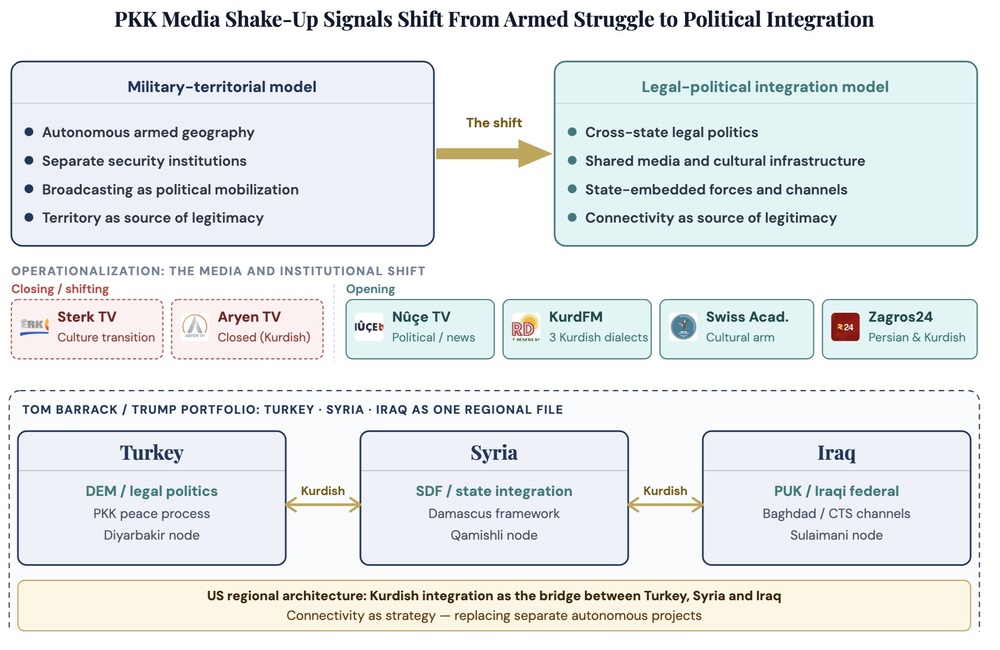
In the latest development, the news-political channel "Nûçe TV" has started its activity since May 15, at the same time as "Kurdish Language Day". This network, which is headquartered in Germany, has also opened offices in Diyarbakir, Qamishlo and Sulaymaniyah; The geography that practically draws the new political map of the movement close to the PKK.
During the past decades, Germany has become the most important organizing center of the Kurdish diaspora close to the PKK in Europe. Diyarbakir is the heart of Kurdish legal politics in Türkiye, Qamishlu is the main center of the SDF-related political structure in Syria, and Sulaymaniyah is also under the influence of the Patriotic Union of Kurdistan (PUK); The party that maintains the closest regional relationship with the PKK and the SDF.
Based on this reorganization, it is expected that "Noje TV" will gradually take over the political-news role of "Strek TV" network; A network that hosted PKK senior figures for years, but is now becoming a cultural and non-political media.
This change is not limited to TV. "Zagros 24" channel also replaced "Arin TV" by broadcasting programs in Kurdish and Farsi languages, which previously operated only in Kurdish. Also, "Kurd FM" was launched in Germany through the FED-GEL federation and operates as a pan-Kurdish radio in several Kurdish dialects. Besides that, the "Kurdish Academy" has also been established in Switzerland with a focus on Kurdish language, education and preservation of culture.
Transition from "armed activity" to "cross-border political network"
Analysts evaluate these developments as a part of the strategic transition of the PKK and the currents close to it from the traditional model of "armed power" to the model of "legal and network politics".
The old model of this flow was based on the legitimacy of armed struggle, control of mountainous areas, parallel structures and independent spheres of influence. But the new model relies above all on legal policy, cultural rights, diaspora organization and the presence of Kurdish forces within the structure of regional governments; Without cutting off the cross-border communication of these networks.
In Türkiye, this process is followed by the peace project and the political framework emphasized by Abdullah Öcalan. In Syria, the SDF has adopted the path of integration into the central government structure. In Iraq, the role of Sulaymaniyah and the Patriotic Union of Kurdistan has changed from a "hostile support base" for the PKK - as Ankara previously described - to a channel for managing the transition process.
In this context, the possibility of Mazloum Abdi, the commander of the SDF, meeting with Abdullah Ocalan is also highly symbolic from the eyes of the observers. Such a meeting can reveal the link between the Syrian path and the Turkish peace process and show the integration of the SDF in the structure of the Syrian government not only as a result of regional pressures, but also as a part of the new political strategy of the Ocalan movement.
changing the approach of the United States; From independent Kurdish forces to integration into the structure of governments
Recent developments occur simultaneously with a change in Washington's approach. In the Pentagon's anti-ISIS budget for fiscal year 2027, $61 million in aid to the Kurdistan Region's Peshmerga Ministry has been eliminated, but support for Kurdish-linked forces has not completely ended.
Under this new approach, former SDF forces are now supported as forces integrated into the Syrian Army, and units close to the Patriotic Union are also supported through the official structure of Iraq's counter-terrorism apparatus, rather than as independent KRG forces.
According to observers, this change shows that the US now prefers Kurdish actors to be defined within the framework of the official structures of regional governments, rather than as independent or quasi-governmental entities.
In this regard, the role of Tom Barak, the US ambassador to Türkiye and Washington's special envoy for Syrian affairs, is also significant. He is now simultaneously following the cases of Turkey, Syria, Iraq, Lebanon and Jordan in the form of a single regional framework; An approach that does not eliminate the Kurds, but tries to integrate them into the new security and political order of the region.
A structural challenge for the Kurdistan Democratic Party of Iraq
On the other hand, these developments are described as challenging for the Iraqi Kurdistan Democratic Party (KDP); Because the power of this party is based on the same model that is now weakening: semi-independent regional institutions, family control over the security and economic structure, Peshmerga's direct relationship with the West, and Erbil's position as an independent partner of Ankara and Washington.
While the Patriotic Union can redefine its role through Baghdad and Iraq's federal structures, the KDP will have to cede some of its main components of power to adapt to the new model.
The reduction of Peshmerga budget, the investigation of the US Department of Justice on Mansour Barzani, the long delay in the formation of the new regional cabinet after the 2024 elections and the increasing role of alliances close to the Patriotic Union in Baghdad, are all interpreted as signs of the KDP's strategic weight reduction; However, this party still controls Erbil and Dohuk and has maintained its importance for Türkiye in the fields of trade, energy and border security.

Your Comment