

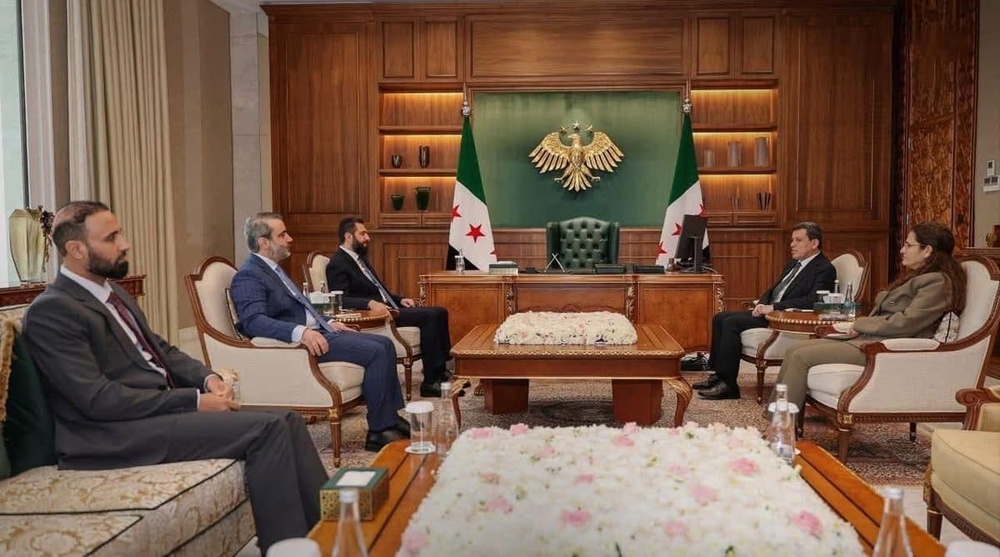
According to Kurdpress, while Syria has entered a new stage of political reconstruction after the fall of Bashar al-Assad's government, indirect parliamentary elections are expected to be held soon in the last areas under the control of the Syrian Democratic Forces (SDF). However, the details of the distribution of seats and backroom deals between political actors have already sparked a wave of criticism and discontent among Syrian Kurdish parties.
According to published reports, out of the total of 15 seats in Haskeh province, 10 seats will be determined through elections, and the other five seats will be directly appointed by the interim president of Syria, Ahmed al-Shara. Among these 10 elected seats, only four seats are reserved for the Kurds; Two seats for the Democratic Union Party (PYD), the political wing of the SDF, and two seats for the Patriotic Council of Syrian Kurds (ENKS), a coalition of Kurdish parties supported by Massoud Barzani, the leader of the Iraqi Kurdistan Region.
This division has faced a negative reaction from a significant part of the Kurdish political currents. In a joint statement, ten Syrian Kurdish parties accused the Syrian interim government of deliberately eliminating other Kurdish forces and declared that the share assigned to the Kurds is much lower than their real demographic and political weight in Syria.
Political engineering to prevent the Kurdish majority
The analysis of the distribution of seats shows that the election structure is designed in such a way that the Kurds cannot achieve a political majority even in areas with a majority Kurdish population. In Hasakah, which is considered the most important population center of Kurds in Syria, the share of Kurds is only 40% of the seats; An issue that, from the point of view of many observers, is a part of the calculated policy of the central government to prevent the formation of an independent regional power of the Kurds.
In Kobani, where two parliamentary seats are being contested, the distribution of seats is expected to be based on ethnic balance; This means that one seat will go to an Arab representative and another seat to a Kurdish representative. This is despite the fact that the demographic structure of the sub-regions around Kobani is such that the Arabs are the majority in some areas, and this issue has been included in the election calculations.
On the other hand, Afrin, whose elections were held earlier, witnessed the complete victory of Kurdish candidates and all three seats in this region went to the Kurds. One of these representatives is also a member of the Syrian Kurdistan Democratic Party (KDP-S); A party close to Barzani's movement.
Despite this, many Kurdish political activists believe that the success in Afrin is more symbolic and does not bring about a real change in the balance of power.
Continuation of the same structural crisis
These developments occur while analysts have previously warned that the main problem of the Syrian elections is not only related to the transparency or the way it is held, but is rooted in the country's new political structure.
According to available estimates, Kurdish groups—whether close to the SDF or independent—could at best win about 15 to 17 seats out of a total of 210 seats in the Syrian parliament; It means about 7% of all seats. Suwayda province, the main center of Syria's Druze population, will also have only three seats in the parliament, which is equivalent to about 1.5% of the total seats.
In such a structure, the Kurds and Druze effectively become less effective minorities in the parliament; That too, in the situation that the parliament itself currently has limited powers vis-a-vis the presidency and does not play a decisive role in the country's major decisions.
Syrian Kurds believe that participating in the current structure will practically mean giving up part of the real and field power in exchange for a limited and symbolic presence in Damascus. The Sweida Druze have similar concerns and fear that participation in the current political process will only lead to legitimizing a structure in which they will play a marginal role.
Proposal to change the governance model
In the current situation, some analysts see the establishment of a bicameral system as a solution to reduce ethnic and regional tensions in Syria. In this model, a parliament is formed based on the population and national elections, and next to it, a parliament similar to the Senate will be created in which regions and ethnic and religious minorities have a guaranteed share.
Supporters of this plan believe that only through such guarantees can the Kurds, Druze and other local groups be encouraged to truly participate in the political structure of Syria.
Otherwise, according to many experts, the new parliamentary elections will not only help to solve the political crisis in Syria, but may deepen the existing gaps between Damascus and the local forces.
Source: National Contest


Your Comment