

Kordpress
During the 38-day war, US President Donald Trump repeatedly accused the Kurds of stealing weapons or concealing them with various absurd words. The recent speech of the President of the United States regarding the "theft of weapons" by the Kurds, rather than arising from an isolated field fact, indicates suffering from a kind of "political melancholia" and lust for speaking in the public space, where the position of the presidency has become a conduit for repeating dialogues dictated by the security institutions. His body language and manner of expression clearly indicate "reading the papers"; An approach that in the literature of communication sciences is a clear example of "directed propaganda" to advance the tactical goals of the White House.In contrast to this style of politics, which has its roots in the two-hundred-year history of the "male cowboy" based on violence and domination, the five-thousand-year history of the Kurds has been written with the essence of bravery, chivalry, and perseverance; A contradiction that clearly draws the border between "authenticity" and "instrumental interest" not only in the field of ethics, but also in civilizational paradigms. This behavior style of the "gentleman cowboy of the White House" is actually a desperate attempt to reduce a rooted nation to "mercenaries who fight only for money", so that the strategic failures of Washington in West Asia can be blamed on local allies.
Donald Trump's statements regarding the attribution of unprofessional and mercenary traits to the Kurds stem from a reductionist and neo-colonialist view that is in absolute conflict with the five thousand-year history and collective memory of this nation. Reducing Kurdish military activism to "fighting for money" is a deliberate disregard of a historical tradition of authentic struggles in which, at different times, Kurdish fighters have not only acted as mercenaries, but have always borne the main burden of resistance against colonialism and tyranny. From Sheikh Mahmoud Hafid's uprising against the British guardianship, to Sheikh Saeed Piran's struggles against authoritarian assimilation policies, they all testify that the motivation of the Kurds throughout history was not financial gain, but the protection of identity and collective will. This historical lineage of struggles, even during the dark era of Baath Party rule and structured guerrilla struggles before 2003, was accompanied by heavy human costs and displacement of millions; The era in which the Kurds' struggle against Saddam's dictatorship, beyond any financial agreement, had a deep connection with the ideal of "the right to self-determination" and in this way, both Kurdish women and men, with a heroic narrative, turned standing against genocidal policies into a model for resistance studies.
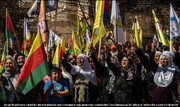
This perceptual gap becomes more obvious when we look at the record of the Kurds' campaign against ISIS in the last decade; The battle of Iraqi and Syrian Kurds against ISIS and especially the Kobani saga was presented to the world as an "ontological" battle for the survival of civilization and democratic values against Salafi barbarism. In this campaign, the prominent role of female Kurdish fighters, who came to the field with the ideology of defending human rights, clearly proved the invalidity of the "mercenary" claim.
The main fear of the observers of the region is the "repetition sequence" of these words, which paints an unjustified and distorted picture of the Kurdish society in the world media. An image that will be a complex and exhausting process to remove from the minds of the global public. In the meantime, a dangerous strategic error is taking place: equating "people" with "party leaders". The authors of Trump's texts, intentionally or out of ignorance, do not differentiate between the Kurdish social body that has paid for freedom and human dignity throughout history, and the party leaders who are now engaged in political survival games.
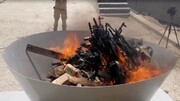
By passing through this layer of discourse and entering the field realities, it must be acknowledged that the "sending of weapons" is true, but the "nature of the story" is completely different from Trump's narrative. Field information confirms that a significant part of these weapons has been deposited by the influence networks of some Kurdish party leaders. Some of these weapons have been sent inside Iran in line with regional equations and with informal coordination, and the other part, according to the statements of some Erbil military commanders, is kept in secret warehouses to be used in "appropriate situations" and according to "secret orders". This "strategic depot" is actually an action to create a "defensive shield" against possible threats and maintain the balance of power in a situation where party leaders find themselves exposed to security attacks.
It seems that by creating an atmosphere of "apparent divergence" between itself and the Kurdish leaders, Washington is trying to reduce the mutual pressure on these leaders by inducing a strategic break; A strategy that gives them the opportunity to advance the long-term goals of the United States in the region with more subtlety and complexity in the shadow of this "gray policy".
Finally, this deplorable situation is caused by the deep crisis of legitimacy in the Kurdistan region; The government that has been running for more than two years in the absence of the parliament and the supervising legal institutions continues to be governed by tribal monarchies. The lack of legal identity and elected institutions have tied the hands of party leaders so that they cannot defend the rights of their citizens against Baghdad, and now, this structural weakness has turned them into "push levers" or "scapegoats" in the hands of American politicians. The current note emphasizes that what Trump attributes to the Kurdish nation as "theft of weapons" is actually "decoding the deadlock of regional sovereignty"; The leaders of the parties, instead of relying on the "national will" and "law", are caught in the fence of the propaganda of a foreign power, and the prestige cost of this predicament weighs heavily on the shoulders of the history and identity of the Kurdish society.


Your Comment