

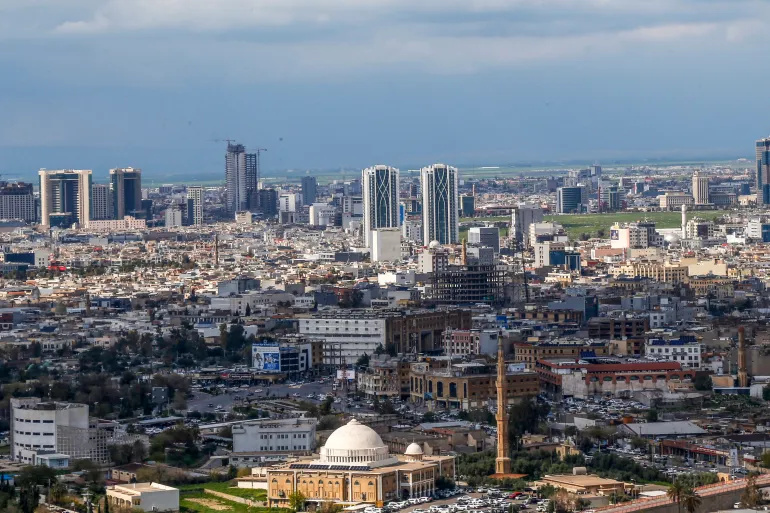
According to Kurdpress, although the Kurdistan Region of Iraq is legally—under the Iraqi Constitution—a single political entity with its own flag and governmental structure, in practice, it has long been divided into two distinct spheres of power. Nearly two years have passed since the parliamentary elections, yet the major parties have failed to form a new government, and the cabinet that has been managing affairs on an interim basis since 2019 remains in office. In reality, the region currently operates with two centers of power rather than a unified government: the Kurdistan Democratic Party (KDP) rules Erbil and Duhok, while the Patriotic Union of Kurdistan (PUK) controls Sulaymaniyah as well as parts of Kirkuk and Erbil province. According to an analysis by *National Context*, key regional and international actors have also effectively accepted this reality. The United States, Turkey, and Baghdad no longer view the Kurdistan Region solely through the lens of a unified government; instead, they engage with each of the two parties as an independent actor. The value of each of these two power centers hinges primarily on two issues: energy and the PKK.
In the energy sector, control over oil lies with the Kurdistan Democratic Party (KDP), while the Patriotic Union of Kurdistan (PUK) controls the gas sector. The geographical distribution of energy resources aligns almost perfectly with the political division of power. Most of the region's oil fields, the export pipeline to the Turkish port of Ceyhan, and the Ibrahim Khalil border crossing are all located in areas controlled by the KDP—an advantage that has made the party Turkey’s most important economic partner over the past three decades.
In contrast, virtually all of the region's major natural gas reserves fall within the sphere of influence of the Patriotic Union of Kurdistan (PUK). Following the completion of the KM250 expansion project in 2025, the massive Khor Mor field will see its processing capacity rise to approximately 750 million cubic feet per day (MMcf/d), with current production already nearing 700 MMcf/d. Additionally, the gas pipeline connecting this field to the Sulaymaniyah power plant has been completed, and the Chemchemal field is slated to supply up to 142 MMcf/d of gas to industrial consumers starting in the second half of 2027.
The significance of this area extends beyond current production levels; two major Iraqi energy contracts have also been concluded within the PUK's sphere of influence.
The analysis emphasizes that while oil remains the Kurdistan Region's primary source of revenue, gas has gained greater significance in today's geopolitical landscape. Currently, approximately one-third of Iraq's electricity is generated using imported gas—a factor that has provided a significant lever for exerting influence over Baghdad. Expanding the Region's gas exports, particularly from areas controlled by the Patriotic Union of Kurdistan (PUK), could reduce this dependency. Meanwhile, the contract for importing 9.6 billion cubic meters of gas from Turkey is nearing its expiration. Consequently, many analysts view the export of the Region's gas via Turkey as the foundation for a long-term partnership between Ankara and the PUK.
Alongside these developments, the Kurdistan Democratic Party’s traditional advantage in controlling the Ibrahim Khalil border crossing is also gradually diminishing. Following the fall of the Bashar al-Assad regime, a new overland route between Iraq and Turkey via Syrian territory has opened up—one that is both shorter and less costly than the traditional route through the Kurdistan Region. The first commercial convoy traversed this route in May, and plans are currently under review to construct a railway line connecting Nusaybin, Qamishli, Rabia, and Mosul. Concurrently, Baghdad has initiated feasibility studies for new pipelines running from Basra to the Turkish and Syrian coasts. Should these projects be implemented, the significance of the Ibrahim Khalil crossing as the sole strategic link between Iraq and Turkey will decline.
The second determining variable is the peace process between Turkey and the PKK. In past decades, when Turkey’s policy was centered on conflict with the PKK, the Kurdistan Democratic Party (KDP) was considered Ankara’s most important local partner. The KDP was a traditional rival of the PKK, controlled areas near the Qandil Mountains, and played a key role in security cooperation with Turkey. Conversely, the Patriotic Union of Kurdistan’s (PUK) close ties with the PKK consistently posed a security challenge for Turkey; Ankara even went so far as to close Sulaymaniyah’s airspace and shut down the PUK’s representative office in Turkey. However, the onset of the peace process has inverted this equation. Turkey now requires—more than just a military partner—an actor capable of communicating with the PKK. In this context, the very closeness of the Patriotic Union of Kurdistan (PUK) to the PKK—once considered a liability—has turned into an asset. The holding of a symbolic PKK disarmament ceremony near Sulaymaniyah, the opening of a Turkish visa office in the city, and the PUK’s position at the center of the triangular relationship between the PKK, the Syrian Democratic Forces (SDF), and Turkey all signal this shift. Conversely, as the peace process advances, the value of the Kurdistan Democratic Party’s (KDP) traditional role as an anti-PKK partner diminishes.
In the author's view, the United States, Turkey, and Baghdad not only do not object to the existence of two power centers but actually regard it as a strategic advantage. The presence of two rival parties ensures that neither can unilaterally monopolize control over relations with Turkey, transit routes, or the Region's strategic decision-making. Both parties consistently act as a counterweight to one another, thereby preventing either from becoming an irreplaceable player. Today, the two main parties in Iraqi Kurdistan are pursuing distinct strategies: the Kurdistan Democratic Party (KDP) continues to prioritize greater autonomy, reliance on an independent network of foreign relations, control over oil resources, and the preservation of its traditional standing. In contrast, the Patriotic Union of Kurdistan (PUK) has invested in greater integration into the Iraqi state structure, cooperation with the Turkish peace process, and the leveraging of gas resources to advance the shared objectives of Baghdad, Ankara, and Washington. In the author's view, within the new regional order—which relies more than ever on economic connectivity, cooperation with central governments, and the de-escalation of security tensions—the latter approach has currently gained the upper hand. Nevertheless, the Kurdistan Democratic Party (KDP) has not been eliminated from the equation, nor has the PUK supplanted it; rather, both have—in their own distinct ways—become indispensable players for regional and international powers.


Your Comment