

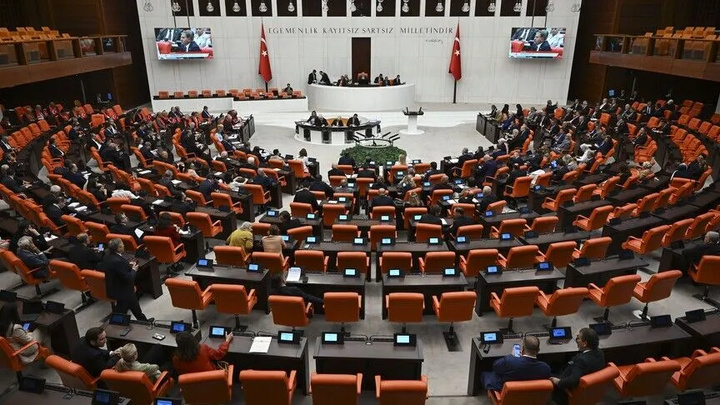
According to KurdPress, the approval of the framework law in the Turkish parliament cannot be assessed as the end of the issue, nor as a mere retreat or surrender of the Kurdish movement. The main significance of this development lies elsewhere: for the first time, a process that has been followed for nearly half a century mainly in the field of security and armed conflict has entered the legal and parliamentary framework.In this sense, the Kurdish issue has moved from the logic of “conflict security management” to a stage where law, political institutions and oversight mechanisms should determine the future course.
This shift is important because the experience of the past four decades has shown that security measures alone have not been able to solve the problem. Between 1985 and 2014, the Turkish government passed 11 laws in an attempt to resolve the conflict, but these laws focused mainly on amnesty, repentance, confession and individual withdrawal from the organization and failed to create a comprehensive political and social mechanism. The current law is qualitatively different in this respect, as it links the end of the armed conflict, the return of individuals, the legal consequences of this return and the monitoring of the implementation of the process to a set of legal and parliamentary arrangements.
However, this development should not be equated with the resolution of the Kurdish issue.The Framework Law is more than a “law to resolve the Kurdish issue”; it is a law to transition from armed conflict to politics and rights. In its text, fundamental demands such as equal citizenship, language rights, education in the mother tongue, the end of the guardianship system over locally elected institutions, and the determination of the status of Abdullah Öcalan and political prisoners are not fully addressed. Not even the word “Kurd” is in the text of the law. Therefore, the gap between the end of the war and the resolution of the political, cultural, and legal roots of the problem remains.
From here, the first important contradiction of the process becomes apparent: one side of the conflict has taken irreversible steps, but the legal and political response of the government is still limited and phased. This imbalance cannot be ignored. However, rejecting the entire process on the grounds that the government’s response is inadequate does not necessarily correct this imbalance; it can even perpetuate it.The logic of the framework law is to remove the return of forces and the end of armed activity from an ambiguous and risky situation and to define a legal procedure for it; the experience of the Hubur crisis in 2009, when the return of a group of individuals without a legal framework turned into a political crisis, is one of the most important lessons of this stage.
On the other hand, the concerns of nationalist and security-oriented currents about the weakening of the state or the disintegration of Turkey cannot be dismissed simply by labeling. But this concern distances itself from the reality of the text of the law when it treats the end of the conflict as equivalent to unilateral concessions. The logic of the current agreement is based on the assumption that the dissolution of the organization and the laying down of arms, on the other hand, obliges the state to regulate the legal consequences of this development.Also, the process documents do not call for the disintegration of Turkey, and the stated goal is to transfer the issue to the arena of democratic politics within the framework of the common future of the country.
In fact, if the issue is transferred from the battlefield to the arena of politics, the concept of power also changes. During the war, weapons were considered the most important bargaining tool; but in democratic politics, power can come from social organization, the votes of millions of citizens, public legitimacy, and the ability to mobilize politically. Therefore, changing the means of struggle does not necessarily mean losing political power. On the contrary, it can provide the opportunity to transform scattered and armed demands into institutionalized demands that can be pursued in the public arena.
This is where the criticism from parts of Kurdish society and leftist forces becomes important.If the war is to end, they ask, why have the rights to education in one’s mother tongue, equal citizenship, Öcalan’s release, and reform of the security and political structures not yet been enshrined in law? This criticism is politically serious, as it points to the danger of the peace process becoming simply “disarmament and administrative integration.” If the framework law fails to gradually pave the way for broader political reforms, it may simply change the form of the conflict rather than resolve it.
But from another perspective, the end of violence could create exactly the political space that leftist, civil, women’s, workers’, and social activists forces need to pursue their demands. In a situation where national security has become a means of justifying the restriction of many social demands over the past decades, reducing the role of the armed conflict could remove part of the justification for these restrictions.Peace and structural transformation are therefore not two completely separate stages; the end of the war can be a precondition for a broader political struggle to reform democratic structures.
Of course, the greatest risk is reliance on government intentions. The question of whether the government really intends to solve the problem or whether it wants to buy time and manage the process until the 2028 elections remains valid. But this question cannot be answered by guessing about the intentions of political actors. The criterion must be tangible results: will prisoners be released? will the return of individuals be guaranteed by law? will political and cultural rights enter the official agenda? will the trusteeship system over elected institutions end? and will subsequent government decisions be subject to oversight and guarantees?
From this perspective, the most important response to distrust is not trust; it is to create guarantee mechanisms.If the process is based solely on mutual trust, it will be vulnerable. But if the implementation of commitments to law, parliament, public oversight, and the political costs of non-compliance are tied up, its possibility of continuation increases. In such circumstances, even the existence of government electoral calculations does not necessarily render the process meaningless; because any peace process ultimately proceeds within a real political arena and accompanied by power calculations.
The same applies to the accusation of “surrender.” Surrender means when one side gives up its demands. But demands such as equal citizenship, language and education rights, local democracy, justice, truth-seeking, and the release of prisoners remain. What has changed is the means of pursuing these demands: a move from armed struggle to organization and democratic politics.From this perspective, the dismantling of the armed structure cannot be automatically equated with the dismantling of political demands.
At this point, the experience of other resolved conflicts also makes an important point. From Northern Ireland to Colombia, South Africa and Nepal, the first agreements have usually not covered all the demands of the parties to the conflict. The importance of the initial agreement has not been its completeness, but rather in providing a framework for the continuation of the process. The main issue after the agreement is how to sequence the measures, guarantees, monitoring and filling the implementation gaps. Therefore, the inadequacy of the framework law is not in itself sufficient reason to invalidate it; the decisive question is whether it makes the next stage possible.
However, peace is not secured simply by the cessation of arms. The issue of historical memory and victims is also part of the future of the process.The Turkish and Kurdish families who lost their children in this conflict are both part of the country’s history of suffering. The goal of the peace process should not be to compare or rank suffering, but to end the production of new suffering. If the current process cannot ultimately lead to a mechanism for truth, accountability, and confronting the past, legal peace has not yet translated into social reconciliation.
Ultimately, the main issue now is not whether the framework law is “sufficient” or “insufficient.” It is clear that it is not sufficient. The question is whether it is an end point or a beginning point.The evidence in the text suggests that it should be seen as the beginning of a new phase; a phase in which unresolved issues such as the legal status of Abdullah Öcalan, the status of senior members of the organization, education in the mother tongue, the mechanism of truth and facing the past, the end of the guardianship and release system, and addressing the situation of sick prisoners, are transferred to the political arena.
Therefore, the adoption of the Framework Law can be considered the most significant change in the nature of the course of the Turkish Kurdish issue in recent decades, but not because it has solved the issue. Its importance lies in the fact that for the first time it links the end of the armed conflict to a legal and parliamentary process. This law is neither a “surrender pact” nor a “final peace agreement”. It is more like a legal framework for the transition from a historical period to a period in which the conflict must be pursued with the tools of politics, law, and social organization.For this reason, the real success or failure of this process will not be determined on the day the law is passed; it will be determined in the months and years that follow. If the law leads to the safe return of individuals, the release of prisoners, the expansion of political and cultural rights, the reform of democratic structures, and the real participation of society, it could become a launching pad for resolving the Kurdish issue. If it stops at the level of disarmament and political and legal demands remain pending, there is a risk that the conflict will shift from a purely armed form to another political and social form.
Consequently, the real turning point is not the passage of the law; the real test is the transformation of “law” into “right” and the transformation of the end of the war into democracy. What has now begun is not the end of the struggle for Kurdish rights; it is the transition of this struggle from the mountains to parliament, from weapons to politics, and from the logic of security to the arena of law.
Source: Amarji Magazine




Your Comment