

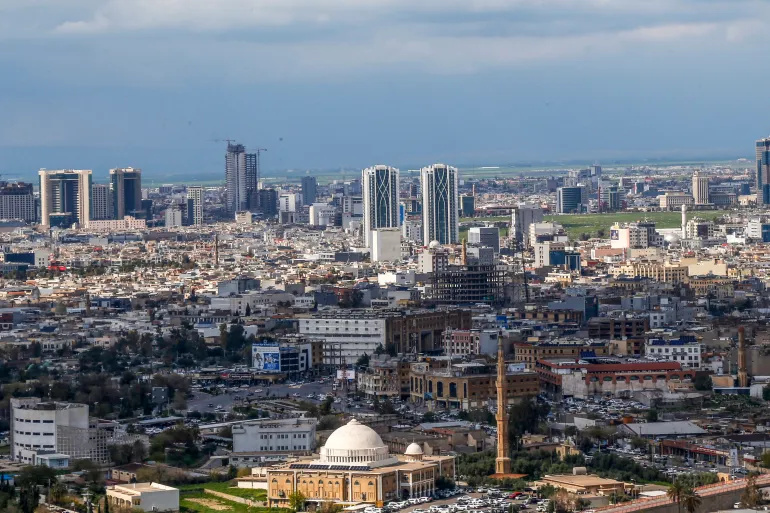
The crisis in the Strait of Hormuz, through which approximately 3.2 to 3.5 million barrels of Iraqi oil passed daily, has effectively deprived Baghdad of its primary revenue stream. Iraq's oil production has plummeted from 4.2 million barrels per day to roughly 1.4 million barrels, placing the country in an unprecedented predicament. In this context, the Iraq-Turkey Pipeline (ITP), which traverses the heart of the Kurdistan Region, remains the only viable export artery. An agreement brokered by direct U.S. mediation between Baghdad and Erbil has resumed oil flows through this route, with exports reaching approximately 250,000 barrels per day. This historic reversal has, for the first time, made the federal government reliant on Erbil's cooperation to secure its oil revenues.
The Kurdistan Region's energy potential extends far beyond oil, with its natural gas reserves offering vast prospects. According to a report by the Atlantic Council, the Region's proven gas reserves are estimated at approximately 25 trillion cubic feet, accounting for 20 percent of Iraq's total gas reserves. The Kurdistan Region's Ministry of Natural Resources has put potential resources at up to 198 trillion cubic feet, representing roughly three percent of global reserves. The U.S. Geological Survey also believes that undiscovered resources in the Zagros fold-and-thrust belt—a significant portion of which lies within the Region—amount to some 54 trillion cubic feet of gas. Key fields such as Khor Mor and Chemchemal are central to these developments. The Khor Mor field, operated by a consortium of Emirati, British, Austrian, Hungarian, and German companies, supplies over 80 percent of the Region's electricity and has attracted more than $3.5 billion in investment. Current gas production in the Region stands between 540 and 680 million cubic feet per day, with a target of reaching 1.5 billion cubic feet by 2027.
Signs of a decisive American return to the region's energy equations are evident. During the Kurdistan Region Prime Minister's visit to Washington, agreements worth $110 billion were signed with U.S. companies HKN Energy and WesternZagros to develop the Miran and Kurdamir gas fields. These deals, located in Sulaymaniyah province—historically considered within Iran's sphere of influence—represent a direct challenge to Tehran's influence in northeastern Iraq. U.S. and allied pressure has also reduced Russian oil giant Rosneft's stake in the Kurdistan Region pipeline company from 60 percent to 49 percent, underscoring Washington's efforts to exclude geopolitical rivals from the Region's energy equations. The opening of the largest U.S. consulate in the world in Erbil, at a cost of roughly $800 million, and the redeployment of a significant portion of U.S. military forces to the Harir base in the Kurdistan Region, attest to Washington's commitment to a long-term presence in the area. Tom Barak, the U.S. special envoy for Syria, directly welcomed the Baghdad-Erbil agreement to resume oil exports, commending both sides for their courage and cooperation.
Despite these unprecedented opportunities, the path to transforming the Kurdistan Region into a reliable energy anchor faces serious obstacles. The Region's energy infrastructure is highly vulnerable to attacks by Iranian-backed militia groups, and a widespread drone campaign last summer slashed oil production from about 280,000 barrels per day to just 80,000. The Khor Mor field has also been repeatedly targeted by rocket and drone strikes. Kurdish officials have attributed these attacks to armed groups, including certain factions of the Popular Mobilization Forces. Although Baghdad has launched investigations, no specific perpetrators have been identified.
Legal challenges and historical disputes between Baghdad and Erbil compound these difficulties. The federal government, citing rulings by the Federal Supreme Court, has declared the Region's independent contracts with foreign companies illegal, with Iraq's Oil Ministry labeling them a "blatant violation" of the law. These disagreements keep the Region in a legal gray area, exposing long-term investments to considerable risk. Financial strains further aggravate the situation; the Kurdistan Regional Government faces approximately $33 billion in debt and remains heavily dependent on budget transfers from Baghdad. The two-and-a-half-year pipeline shutdown—from March 2023 to September 2025—delivered a heavy blow to the Region's economy, forcing it to accept more stringent terms in negotiations with the federal government.
Analysts also point to a fundamental contradiction in U.S. policy. While Washington seeks to strengthen the Kurdistan Region as a counterweight to Iranian influence, it is wary of empowering it to the point where it might revive independence aspirations, which could destabilize Iraq and unsettle neighboring countries, particularly Turkey. This paradox—sometimes referred to as the "autonomy trap"—has made Washington hesitant to provide the Region with advanced air defense systems, as such a move could be interpreted by Baghdad as arming a non-state actor against the central government.
Evidence suggests that the Kurdistan Region is gradually becoming an energy anchor for the United States in the new Middle Eastern order. The Strait of Hormuz crisis and the fall of the Assad regime have created an unprecedented opportunity for the Region to evolve from a budget-dependent enclave into a strategic lever for Iraq's economic survival and a key player in regional energy dynamics. However, success on this path hinges on the Region's ability to secure its energy infrastructure against militia attacks, resolve legal disputes with Baghdad through a lasting oil-and-gas agreement, and attract and retain investment in energy infrastructure despite security and legal risks. Should these challenges remain unaddressed, this golden potential could devolve into a vulnerability, inviting external pressure and fueling further regional instability. The new energy order of the Middle East has placed the Kurdistan Region at the epicenter of geopolitical tensions, and its future depends above all on the astute management of these very tensions.




Your Comment