

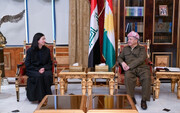
According to KurdPress, the sudden death of Lindsey Graham, a Republican US senator, was accompanied by an unprecedented reaction from Kurdish leaders. Due to the time difference, many Kurdish officials issued their condolences before the American public was aware of the news.Nechirvan Barzani, the president of the Kurdistan Region, praised Graham for his “steadfast support” for Kurdistan, Qubad Talabani called him “a true friend of the Kurdish people,” and Mazloum Abdi, the commander of the Syrian Democratic Forces, expressed deep sorrow over his death.
These reactions showed that Graham had become one of their most important supporters in Washington in the eyes of many Kurds. However, his political record is much more complex than the image that has been formed of him in Kurdistan. This difference raises a fundamental question: to what extent are “friends of the Kurds” in American politics based on a commitment to Kurdish rights and to what extent are they subordinate to US strategic interests?
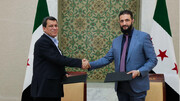
The fact is that Graham was one of the few American politicians in recent years who, despite Washington’s reduced focus on the Middle East, continued to take a stand on Kurdish issues.During the Turkish military operation in northeastern Syria in 2019, he criticized Donald Trump's decision to withdraw American forces and warned again in 2026 about the consequences of the attacks of the Ahmed al-Sharaa government against the Syrian Democratic Forces .
Despite this history, Graham’s support for the Kurds cannot be analyzed in isolation from his other foreign policy priorities. He was one of the most staunchly anti-Iranian figures in the US Senate, and many of his positions on Iraq and Kurdistan fell within this framework. For example, after the retaken of Kirkuk by the Iraqi army and other forces in 2017, Graham saw it as increasing Iranian influence in Iraq rather than emphasizing the consequences for the Kurds.
Also, contrary to popular belief in Kurdistan, he did not publicly support the Kurdistan Region’s independence referendum in 2017. According to sources close to the region’s leaders, Graham had warned them in private meetings against holding a referendum and advised them to remain within the Iraqi framework, believing that Washington could meet their demands in other ways.
Overall, Lindsey Graham was undoubtedly a prominent supporter of the Kurds in Washington, but his influence in American politics was more limited than many in Kurdistan had imagined. His advocacy failed to lead to fundamental changes in American policy toward the Kurds, and even his most important initiative, the “Save the Kurds Act,” was never implemented.
Now that Graham has stepped down from the political scene, his void may be an opportunity for Kurdish leaders to develop a more realistic and diverse network of allies in the United States. Graham’s experience shows that relying on a symbolic figure, however influential and sympathetic, is no substitute for a sustainable strategy to secure Kurdish interests in American politics.


Your Comment