

According to KurdPress, Dr. Joshua Landis, a prominent researcher on Syrian issues at the University of Oklahoma, in an analysis of the recent tensions between Arab tribes and Kurdish forces in northeastern Syria, believes that the main root of the dissatisfaction of Arab tribes lies not only in the dispute with the Kurds, but also in the economic situation, the feeling of historical deprivation, and competition over the region's resources.According to Landis, the center of tribal discontent in the Deir Ezzor region is the dire economic situation, a situation exacerbated by the central government’s indifference and the diversion of regional resources to projects favored by Damascus. This is not a new story, he writes; during the rule of Bashar al-Assad, the oil, phosphate, and agricultural resources of northeastern Syria were largely at the service of the government’s priorities, and the same trend seems to be repeating itself under Ahmed al-Sharaa.
He notes that the oil resources of northeastern Syria are very attractive to Damascus, and the new government may allocate the region’s revenues to projects it considers more important, including strengthening the country’s military structure.
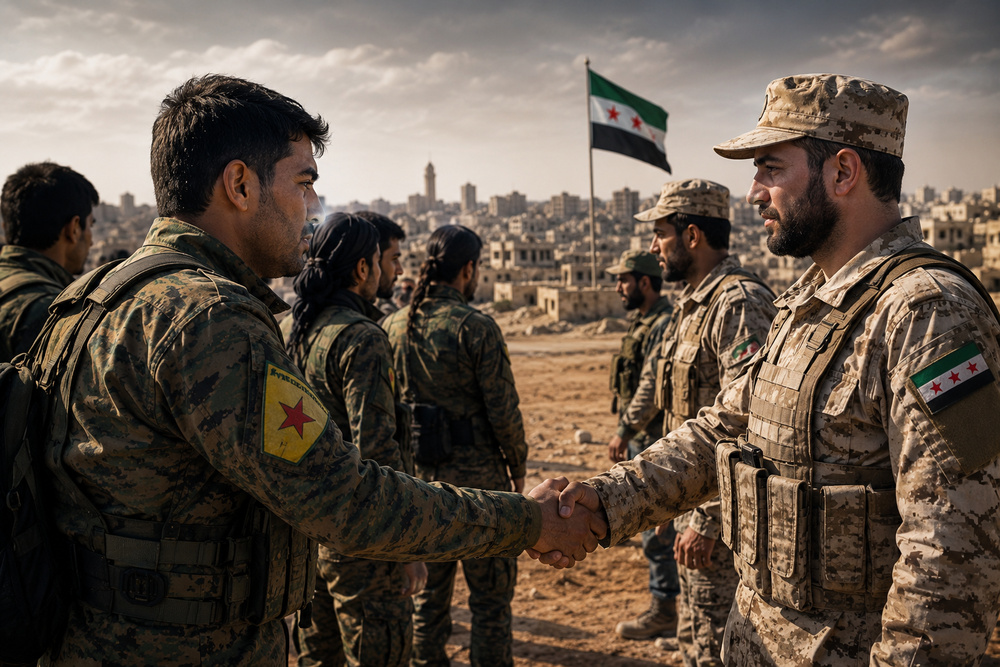
According to Landis, analysts have put forward various reasons for the Arab tribes’ dissatisfaction with the Kurds. The Syrian Democratic Forces (SDF) still retains some of their former influence and structures in northeastern Syria, but their reduced territory and control of natural resources have weakened their position.
He believes that Donald Trump’s direct intervention prevented the SDF from completely collapsing. According to Landis, US Secretary of State Marco Rubio announced that Trump personally spoke with Ahmed al-Sharaa to prevent further fighting in January. France also intervened in February to stop the advance of Arab tribes into the Kurdish-dominated areas of Hasakah and Qamishli.
However, Landis assesses the future of the SDF as difficult, saying that the loss of territory and natural resources has forced the forces to accept Damascus’ demands.He predicts that Ahmed al-Sharaa will gradually reduce the remaining powers of the Kurds in an attempt to centralize power in Damascus.
In Landis’s view, the Arab tribes’ threat to attack Kurdish areas is actually an attempt to draw attention to their own problems. The tribes expected to have greater control over the region’s resources after the Assad regime left, but now they feel that the resources are still in the hands of the central government. “The Arab tribes are not mobilizing to take resources from the Kurds; they are unhappy that Damascus has taken them from them,” he writes.
In this context, the 25-year contract of the American company HKN Energy to manage and exploit oil fields in northeastern Syria, including the Rmailan fields in Hasakah province, has become a factor in the region’s sensitivities.
Landis also points to internal divisions among Arab tribes. The Uqeidat (Agidat) tribes have managed to gain some important security and political positions, including the appointment of Hussein al-Salamah, a resident of the city of al-Shaheel, to a high security post and quotas in the new Syrian parliament.
However, some tribal leaders, such as Ammar al-Hadawi, believe that the central government still retains control of local resources and that the promise of real decentralization has not been fulfilled. In contrast, the large Baggareh tribe has failed to gain a proportionate share in the formal structure of the new government, and its leaders have accused the government of deliberately marginalizing the tribe. Although some figures from the tribe, such as Sheikh Nawaf al-Bashir, have supported Ahmed al-Sharaa, they have not been given a large formal role in decision-making centers.
Conclusion
For Joshua Landis, the Arab tribes’ rebellion or armed mobilization against the Kurds in northeastern Syria cannot be seen as a purely ethnic conflict. The crisis is the result of a combination of factors:
Eastern Syria’s historical economic deprivation;
Competition over control of oil and natural resources;
A sense of exclusion of Arab tribes from the new power structure;
The weakness of the PA’s development project;
Damascus’s attempt to reconcentrate power;
And the central government’s potential use of Arab-Kurdish divisions to control the region.
In his view, the real problem with the Arab tribes is not so much the “Kurds” as the sense of continuity of the old pattern: that the resources of northeastern Syria are being given to others, but the local people remain poor.
Source: Dr. Joshua Landis’s personal page on X-Network



Your Comment