

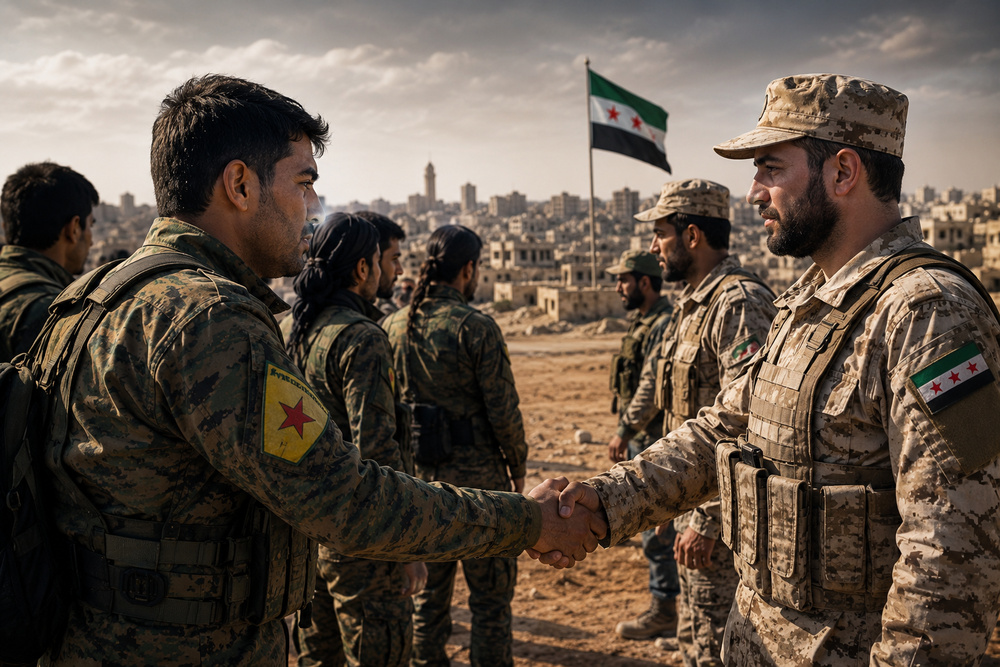
According to KurdPress, the process of integrating the Kurdish forces into the Syrian military structure has approached a critical stage, while the most important question about the future of this process is not how the military activity of the Syrian Democratic Forces will end, but rather the fate of the rights and political status of the Kurds after this integration.According to the analysis of Yunus Abakay, a researcher at the Institute of Arab and Islamic Studies at the University of Exeter, what is taking shape may be more of an “annexation” of Kurdish structures into the centralized Syrian state system than a true “integration,” because the necessary legal and institutional mechanisms to guarantee the political status of the Kurds have not yet been established.
The integration of the Syrian Democratic Forces into the Syrian army could, on the surface, mean the end of a military phase and the beginning of a political phase. However, the fundamental problem is that there is a significant gap between military integration and political integration. If Kurdish forces are absorbed into the Syrian army, but political rights, participation in parliament, participation in national decision-making, and the position of Kurdish regions in the country’s political structure are not legally guaranteed, the end of the existing military structure will not necessarily mean a solution to the Kurdish issue.One of the most significant gaps in the current process is the lack of a clear constitutional agreement. Agreements between Damascus and the SDF can provide a framework for cooperation, but until the main provisions of these agreements are entrenched in the Syrian legal structure, they are open to change or reinterpretation in the future. The experience of the Syrian civil war has shown that political agreements without institutional and legal backing are vulnerable to shifts in the balance of power.
Another problem is the lack of a clear power-sharing mechanism. The integration of Kurdish forces into the Syrian army alone does not determine what place the Kurds will have in Syria’s future political structure. The fact that a number of Kurdish commanders or figures will hold positions in the army or the central government is fundamentally different from the creation of a stable system for Kurdish political participation.In the first case, individuals are absorbed into the power structure; in the second, a political community participates in power through legal and electoral institutions.
This difference is of great importance for the future of the Kurds. If the SDF were to be dissolved and its members were to be absorbed individually into the military and state structures, the link between these individuals and their social and political base might also be weakened. In such a situation, the presence of Kurds in government institutions would not necessarily mean that Kurdish society would have political power, but might simply be limited to the presence of a number of Kurdish officials in a centralized structure.
On the other hand, the current process relies heavily on external guarantees.The SDF’s relations with the US and European countries, as well as the role of the Kurdistan Region in trying to secure the agreements, show that there are still insufficient domestic mechanisms to guarantee the implementation of the agreement between Damascus and the Kurdish side. These relations can increase the cost of violating the agreement for Damascus in the short term, but they cannot replace permanent and legitimate institutions.
The dependence on external guarantees becomes even more important because the presence of these actors may decrease in the future. The gradual decrease in the US presence in the region, the changing priorities of European countries, and the Kurdistan Region’s focus on domestic issues and its relations with Baghdad could reduce the level of external attention to the Syrian Kurdish case.In such a situation, if external guarantees are not translated into internal institutions, the Kurdish side’s ability to prevent unilateral changes to the agreements will also be reduced.
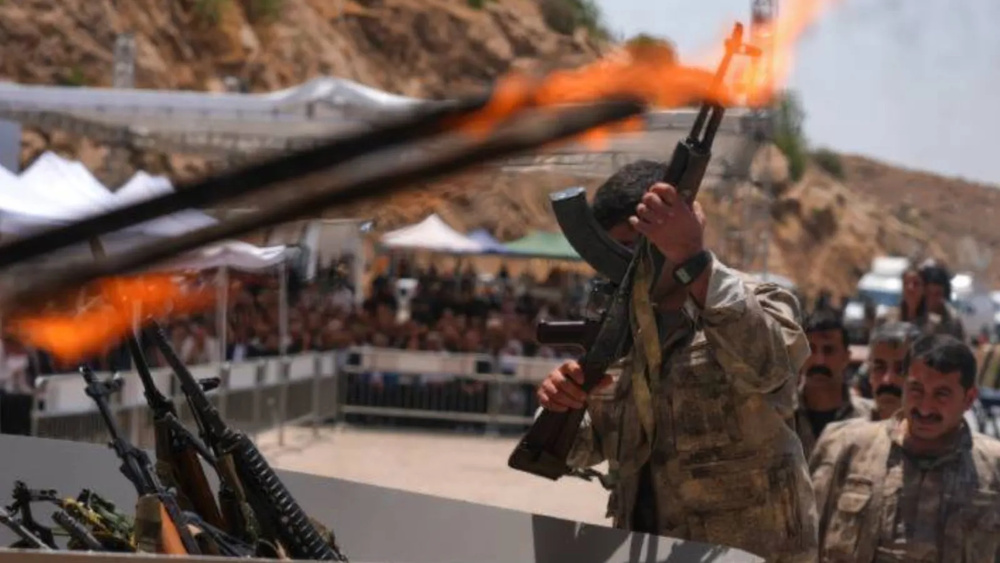
Meanwhile, the Syrian Democratic Forces have lost a significant part of their material leverage in the course of recent developments. Control of parts of the territory, economic and oil resources, and responsibility for holding ISIS prisoners have been among the tools that gave these forces bargaining power in the past. Transferring or handing over these levers to the central government, if not accompanied by the creation of political and legal guarantees, could shift the balance of power even further in Damascus’ favor.
In this situation, the most important remaining leverage for the Kurdish forces is the cohesion of their forces and the ability to resist unilateral changes in conditions.But using this lever would effectively mean returning to the same military conflict that the integration process was started to end. Therefore, maintaining military power as the ultimate guarantee is not a sustainable solution, and the conflict can only be ended when political and legal guarantees replace military levers.
Meanwhile, the issue of trust remains one of the main obstacles. Damascus wants the Kurdish forces to distance themselves from the role of an internationalized actor and operate within the framework of a unified Syrian government. In contrast, the Kurdish side still needs foreign relations and the support of international actors to ensure the implementation of the agreements. These two approaches are seemingly contradictory. The more the Kurdish side relies on foreign guarantees, the more Damascus may see it as a sign of maintaining parallel structures and not fully accepting the authority of the central government.For this reason, the end of the military structure of the Syrian Democratic Forces cannot be considered the end of the Kurdish question in Syria alone. The main issue after integration will be how to transform Kurdish demands from a military-territorial power into political and institutional rights. If this transition does not take place, a military conflict may end, but the Kurdish political question will remain in a new form.
The difference between “integration” and “annexation” becomes apparent precisely at this point. Integration means that a group or community participates within the framework of a common system, while preserving its political and social rights and characteristics. However, annexation occurs when a weaker structure is absorbed into a centralized hierarchy of power without institutional guarantees.
If the current process is to lead to a real integration, it is necessary to determine the future legal and political framework before the complete dissolution of the Kurdish military structures.Constitutional guarantees of Kurdish rights, the establishment of clear mechanisms for and sharing power, ensuring electoral participation, and determining the place of Kurdish areas in the administrative and political structure of Syria are among the issues that cannot be postponed to an unknown stage in the future.
Otherwise, the dissolution of the Syrian Democratic Forces may help resolve the military issue between Damascus and the Kurds, but leave the issue of Kurdish political participation unanswered. In such a situation, the Kurds may have given up a significant part of their military and economic leverage, without receiving adequate legal and political guarantees in return.
From this perspective, the post-integration phase is more important than the integration process itself. The success of this process will be measured not by the number of Kurdish forces absorbed into the Syrian army, but by the extent to which the Kurds’ political and institutional rights are consolidated.If military integration is accompanied by constitutional reform, political participation, and power-sharing mechanisms, it could pave the way for a new political order in Syria. But if these elements remain absent, there is a risk that “integration” will simply become a name for the gradual absorption of Kurdish structures into a centralized system.
Ultimately, the main issue for the future of the Syrian Kurds is no longer simply the preservation of a military force or a defined territory; it is rather the translation of the achievements of the military era into guaranteed political rights. The current window, in which foreign actors still have considerable interest in the Syrian political process, provides an opportunity to create such guarantees. If this opportunity is missed, the reduction of the foreign presence and the changing priorities of regional actors could create a situation in which the central government has fewer institutional constraints to redefine or even retreat from its commitments.The main challenge facing the process of Kurdish integration into the Syrian army is therefore not to end the military structure of the Syrian Democratic Forces; but to prevent the end of this military structure from also ending the bargaining power of the Kurds, without creating a stable political and legal framework. Integration can lead to stability only if the Kurds have a clear position, not as assimilated forces, but as a political community with rights and partners in the new Syrian structure. Otherwise, what is called “integration” on paper may in practice be nothing more than “annexation.”
Your Comment