

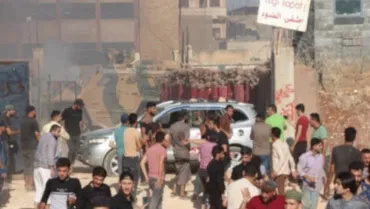
According to KurdPress, the recent protests in Hasakah province, especially the attack on the convoy of the governor of this province in the city of Ras al-Ayn (Sari Kaniyeh) on July 22, are not merely a local unrest from the perspective of Haed Haed; rather, they are a sign of the deep political, economic and social divisions in northeastern Syria, which could turn into a wider crisis if the Damascus government ignores them.In the author’s opinion, the incident, which coincided with the reopening of the Aluk water station, rather than demonstrating the government’s success in restoring public services, revealed the extent of people’s dissatisfaction with the process of managing the transition in Hasakah.
Hasakah, one of Syria’s most important provinces in terms of oil, water, and agricultural resources and home to a significant Kurdish population, has been under the self-governing administration of northern and eastern Syria for years. Now, with the beginning of the process of integrating this region into the central government structure, tensions have increased, especially in the predominantly Arab areas of the southern part of the province, and trust between the people and the government is declining.
Livelihood crisis and sense of deprivation
Hayed says that the most important factor in discontent is the deterioration of living conditions. The shortage of drinking water, bread, and fuel, increasing poverty, and the inability of some families to meet their basic needs have made people’s lives difficult.Moreover, many residents are still unable to return to their villages or access their farmland.
According to the author, people in the region are questioning how a province with such vast oil and agricultural resources can be so severely underserved. They feel that decisions about Hasakah’s future are being made without the participation of local residents.
Detainee cases and distrust
Another issue is the fate of detainees previously held by the Syrian Democratic Forces (SDF). Protesters are demanding their release, as well as transparency about those who were reportedly transferred to Iraq along with some ISIS prisoners.The author believes that, despite the fact that about seven months have passed since the beginning of the process of merging the Syrian Democratic Forces with the Syrian government, a reliable mechanism has not yet been established to address these demands. This has fueled distrust in the security institutions and the central government.
Criticism of the way the province is run
Haid Haid believes that the appointment of the governor and members of the provincial executive council has also become one of the main axes of the protests. Critics say that people close to the Syrian Democratic Forces or its affiliated institutions have gained a greater share in the new power structure, while other social groups and independent local figures have been excluded from the decision-making process.According to him, the main problem is not simply the distribution of positions, but the perception among a significant part of the residents that the future of Hasakah is determined in negotiations between Damascus and the Syrian Democratic Forces, without the people of the region having a role in this process.
The risk of an escalation of the security crisis
The author warns that the protests are moving from the stage of civil demands to a tribal confrontation. The formation of “war tents” by some tribal sheikhs is seen in the nomadic tradition as a sign of general mobilization and readiness to use force; a sign that should neither be exaggerated nor ignored.Haid Haid believes that if the crisis continues, there is not only the risk of conflict between Arab tribes and the Syrian Democratic Forces, but also that ISIS cells, rival armed groups and regional actors may exploit the instability to expand their influence or carry out security attacks.
Haid Haid emphasizes that there is still time to prevent this crisis from turning into a full-scale conflict, but this time is limited. In his view, the Syrian government must begin direct dialogue with local communities, increase the participation of all social groups in the new provincial institutions and establish transparent and reliable mechanisms to address the demands of the people.
He concludes that the attack on the governor’s convoy showed that the dissatisfaction is no longer limited to sporadic grievances and has now entered a political and security phase.If Damascus fails to demonstrate that the people's demands can be resolved through dialogue and participation, the conflict, which still seems manageable today, could turn into a widespread crisis whose consequences will not be limited to Hasakah or the Kurdish regions of Syria.





Your Comment