

According to KurdPress, Abdullah Öcalan, the imprisoned founder of the Kurdistan Workers' Party (PKK), is a symbolic figure for many Kurds and a hated figure and "terrorist" for a large part of Turkish society. However, the man who led the armed struggle against the Turkish government for decades is now at the center of the most important effort to end the conflict in more than a decade; an effort that ultimately led to his own decision to end the PKK's armed activities.Last year, Öcalan championed a process to end decades of armed conflict, and the PKK finally responded to his call to disarm. On Monday, August 10, 2026, the Turkish parliament took the first legislative step toward ending the conflict by passing a law that would grant limited amnesty and legal immunity to some PKK members. The conflict has left an estimated 50,000 dead.
However, the new law has left Öcalan himself in limbo. He is now 77 and has been held in solitary confinement on the Imrali Island prison near Istanbul since 1999.
“I believe in the power of politics and social peace, not weapons, and I ask you to put this principle into practice,” Öcalan said in July 2025, as the PKK’s disarmament process began. Shortly thereafter, PKK leadersThe PKK, based in the mountains of northern Iraq, symbolically destroyed some of its weapons.
Since the start of the new movement to resolve the Kurdish issue in October 2024, PKK leaders have repeatedly demanded Ocalan's release, calling it essential for the success of the peace process. "He is the one who started this process," senior PKK leader Devrim Palu told AFP last October, and his release is essential for its more effective development.
From the founding of the PKK to the beginning of the armed struggle
Abdullah Ocalan was born on April 4, 1949, in southeastern Turkey, to a rural family of Turkish-Kurdish origin. He turned to leftist activities while studying political science at Ankara University and founded the PKK in 1978.
PKKInfluenced by Marxist ideas, the PKK initially demanded independence for Kurdistan, but later changed its demands to various forms of autonomy and political rights for Turkish Kurds.
Six years after its founding, Öcalan led it into armed struggle. The PKK launched an armed insurgency against the Turkish government in 1984, and conflict between the group and government forces continued for decades.
Ankara quickly declared the PKK a terrorist organization, and the United States, the European Union, and a number of Western countries also added the group to their lists of terrorist organizations.
During the conflict, the PKK used armed tactics and attacks that left many victims.These actions led to Öcalan being recognized by a large part of Turkish society as one of the main enemies of the state, and his opponents calling him the “child killer”.
In contrast, for many Kurds, Öcalan became a symbol of the Kurdish movement and was addressed as “Apo” – the Kurdish equivalent of “uncle”.
Escape, exile and arrest
Öcalan was on the run for years after the start of the armed struggle. He first settled in Syria, but was forced to leave the country in 1998 under pressure from Turkey.
He then went from Russia to Italy and then Greece, and in search of safe haven, he finally reached the Greek consulate in Kenya. On February 15, 1999, Turkish agents arrested him in an operation that the AFP described as resembling a movie.
Öcalan’s arrest dealt a major blow to his supporters, and the Turkish government believed that by arresting the PKK leader,The PKK has managed to eliminate the leadership of the organization.
Öcalan was sentenced to death in court, but after the abolition of the death penalty in Turkey began in 2002, his sentence was commuted to life imprisonment. He has been held in Imrali Prison since then.
Leadership from behind bars
Öcalan's arrest did not mean the end of his political role. Even from prison, he maintained contact with the movement he led and continued to influence the strategic decisions of the PKK.
In 1999, he ordered a ceasefire, which lasted until 2004.
In 2005, Öcalan called on his supporters to abandon the idea of an independent Kurdish state and instead work for autonomy and political rights in the countries where the Kurds live.In 2013, when Recep Tayyip Erdogan was prime minister, Öcalan was once again at the center of efforts to negotiate between the Turkish government and the PKK. The peace talks collapsed in July 2015, leading to one of the bloodiest periods of conflict between the two sides in recent years.
After that wave of violence subsided, there were no more serious attempts at dialogue for years.
Öcalan’s return to the center of the peace process
New developments began in October 2024, when the Turkish government and its political allies sent signals to reopen the path to dialogue with the Kurds.
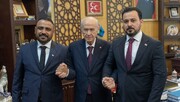
In a significant move, Devlet Bahçeli, leader of the nationalist Harkat party and a close ally of Recep Tayyip Erdogan, extended a hand of friendship to Öcalan, asking him to take steps to end the conflict if he renounced violence.In response, Öcalan declared his readiness to play this role, emphasizing that he could move the Kurdish issue “from the arena of conflict and violence to the arena of law and politics.”
Since then, a small delegation from the Peoples’ Democracy and Equality Party (DEM) has met Öcalan regularly and has played a mediating role between him and Ankara.
This process ultimately led to Öcalan’s call to end the armed struggle and dissolve the PKK. The PKK leaders accepted this call and began the process of disarming and ending their armed organization.
Thus, Öcalan, who had founded the PKK in 1978 as an armed organization with the aim of fighting for Kurdish rights and independence, called for the end of the same armed structure nearly five decades after being imprisoned in Imrali.Framework Law and the Future of the Peace Process
The adoption of the new law by the Turkish parliament on 10 August 2026 is the first important legislative step towards transforming this political process into a legal framework. The law provides for limited amnesty and some legal arrangements for some PKK members who lay down their arms.
However, the issue of Öcalan remains unresolved. The PKK has stressed from the beginning that the release of its leader is essential for the full success of the new process, but the law passed by parliament does not make a clear decision on Öcalan’s fate.
Öcalan sent a hopeful message before the parliamentary vote, calling the passage of the law part of an effort to resolve a historical issue.He said that with this law, Turkey is embarking on a path to resolve a “historical issue” and the beginning of a democratization process that will be “at least as important as the founding of the republic” in 1923. He stressed that now we must work with the same seriousness to create a “democratic republic.”
In this way, Ocalan’s historical paradox has become more apparent than ever: the man who founded an organization for armed struggle against the Turkish state nearly half a century ago is now, from behind bars, calling on the same organization to end the armed struggle and trying to move the Kurdish issue from the battlefield to the arena of politics, law and democracy. The success of this transformation, however, still depends on how the new law is implemented, the fate of Ocalan, the political rights of the Kurds and the readiness of the Turkish government to translate political agreements into lasting reforms.
AFP




Your Comment