

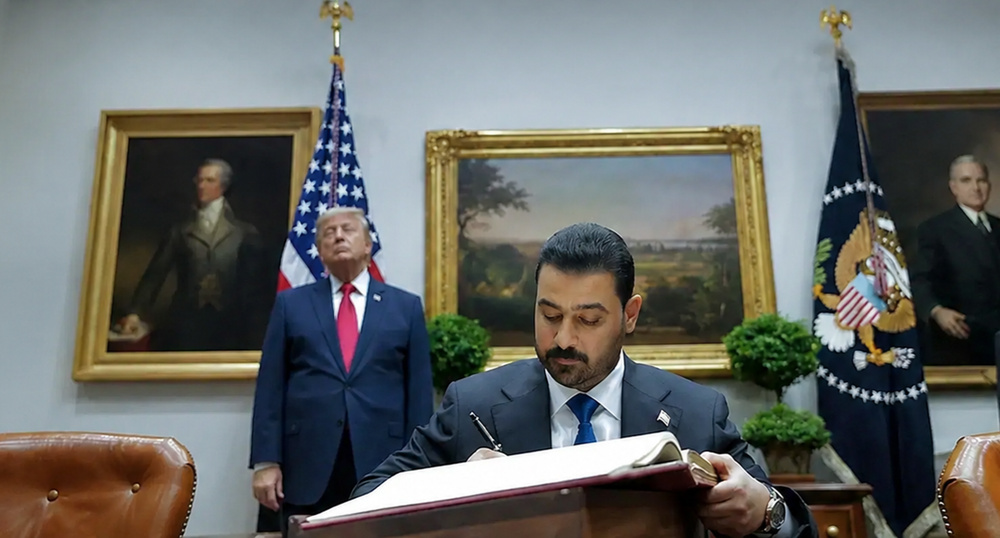
According to Kordpress, the warm and unprecedented relations between Syrian President Ahmed al-Shora and American President Donald Trump have become one of the most important diplomatic developments in the Middle East over the past year. A relationship that has led to the reduction of part of the sanctions, the beginning of security coordination and the opening of political channels between Damascus and Washington. But according to observers, the continuation of this process is not possible without establishing stable and institutional relations between the two countries, and with the end of Trump's presidency in 2028, these achievements can quickly disappear.
In a report written by "Haid Haid" for the English-language magazine "Al-Majlah", it is emphasized that the current relations between Syria and the United States are too dependent on the personal relationship between Trump and Al-Sharia and have not yet reached a level that can withstand the change of governments and future political developments.
Referring to the informal and personal atmosphere governing the relations between the two leaders, the author writes: "Some meetings leave only memories; Apparently, our visit left a scent behind." This was the sentence that Ahmad al-Shara said after receiving the new perfume bottle from Trump; A symbolic act that, according to the author, has become a symbol of personal diplomacy between the two sides.
The report says that this "personal diplomacy" was able to break the ice of relations that had been in an atmosphere of mistrust, sanctions and cut off official communication for years. However, relying too much on personal relationships has created a lot of fragility; Because diplomatic dialogues, security cooperation and economic negotiations are still limited and dependent on a small number of people.
According to this report, like many of its foreign policy cases, the Trump administration has relied more on a circle of people close and trusted by the president, instead of relying on official mechanisms. In the case of Syria, "Tom Barak", the special envoy of the United States, has played a central role in promoting the relations between the two countries.
On the other hand, the centralized management structure in Damascus has caused many Syrian authorities and institutions to not have enough authority and independence to establish stable cooperation with the American side. For this reason, the majority of current relationships are managed through a limited number of people; A situation that slows down the progress and makes the whole relationship more vulnerable.
"Al-Majlah" report adds that although Damascus has created a ground for security coordination with Washington by joining the international anti-ISIS coalition, this cooperation remains limited. Currently, Syria's participation is mainly limited to coordination in some specific operations, and institutional cooperation in the fields of defense and intelligence has not yet been formed.
In the economic and financial sphere, although there have been talks about monetary and financial reforms, practical progress has been slow. The author considers part of this problem to be caused by Syria's dilapidated economic structure, old laws, lack of an active legislative body, and the legacy of years of sanctions and lack of financial transparency.
The report also points to internal differences in the Syrian government over the speed and scope of economic reforms, transparency and governance, and says that these differences have slowed down the process of institutional cooperation with the United States.
In another part of this report, the appointment of "Mohammed Qanatari" as the Syrian Chargé d'Affaires in Washington is mentioned; According to the author, due to his lack of diplomatic experience and his limited familiarity with the American political structure, the appointment was evaluated more based on political loyalty than professional expertise. According to the author, this choice not only did not help to strengthen the institutional relations, but also made the weakness of the official channels between the two countries more obvious.
The author warns that the biggest danger facing Damascus-Washington relations is not the lack of achievements of personal diplomacy, but the inability of these relations to survive after the current actors leave power. According to him, if there is a democratic government in the next US election, it will probably take a different approach towards Syria.
The report predicts that a democratic government may put issues such as democracy, political participation and human rights at the center of its policy instead of focusing on stability, counter-terrorism and regional alignment - which has been the priority of the Trump administration; Issues that have not had an important place in the internal agenda of Ahmad al-Shara and can become a source of tension between the two sides.
At the same time, the author emphasizes that even the coming to power of another republican government does not necessarily guarantee the continuation of the current process; Because the next American president may not have the interest or political investment of Trump in the Syrian case.
According to the author, Damascus does not have much time to turn "political goodwill" into institutional and stable relations. He emphasizes that Syria should as soon as possible empower efficient and empowered officials to negotiate and implement agreements, advance the needed reforms and employ experienced diplomats who have a detailed understanding of Washington and the American decision-making structure.
The report concludes that "personal diplomacy" was able to open the door to a new relationship between Syria and the United States, but only stable institutions and formal relations can keep this door open.


Your Comment