

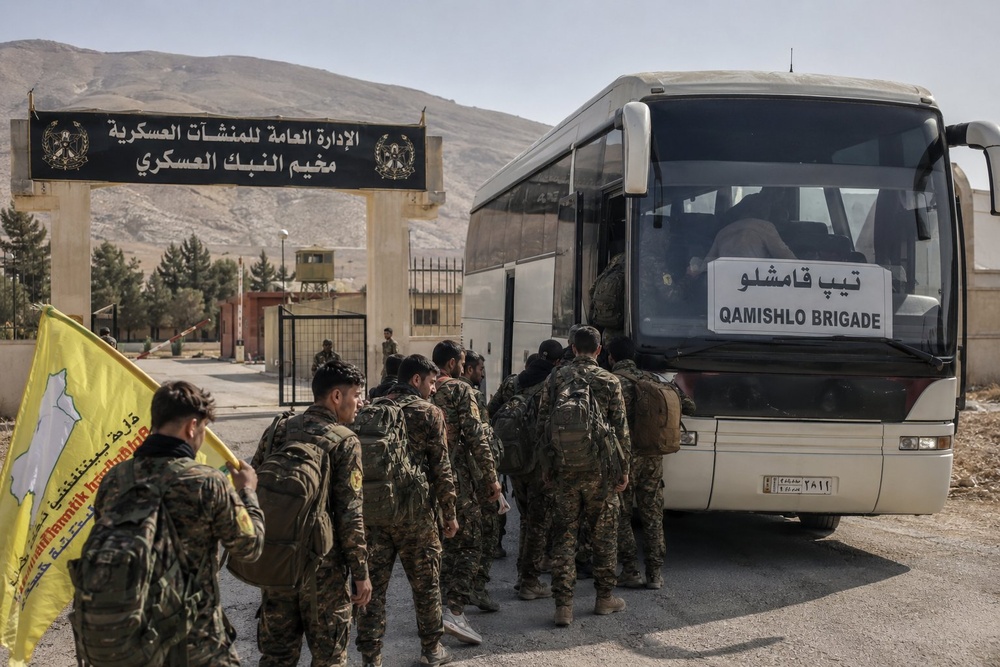
According to Kurdpress, the transfer of the "Qamishlo" brigade, consisting of about 1,300 former forces affiliated with the Syrian Kurds known as the Syrian Democratic Forces or SDF, to the "Al-Nabq" camp in the suburbs of Damascus, is not just a simple training transfer; Rather, it carries important political, military and symbolic messages about the future of the process of integrating Kurdish forces into the new structure of Syria.
The most likely explanation for this action is Damascus's attempt to stabilize the "centralized army" model. Since the beginning of negotiations with the SDF, the government of Ahmed al-Shora has emphasized that its goal is to maintain a single military structure subordinate to the central command, not to continue the semi-autonomous state of northeastern Syria. The transfer of Kurdish forces from Qamishlu to an area near Damascus can be understood in this context. This action shows the distancing of these forces from their traditional geographical and social environment.
In many countries, the transfer of troops outside their native areas is considered part of the process of professionalizing the military and reducing local dependencies. Damascus also apparently wants to convey the message that the merged SDF will now be part of the Syrian National Army, with their deployment and mission determined by the Central Command.
The choice of "Allenbak" is also important from a symbolic point of view. Syria has camps and training centers closer to the Kurdish areas, but sending Kurdish forces near Damascus, rather than due to geographical necessity, seems to be a conscious attempt to show the authority of the central government and the seriousness of the integration project. This action can be a direct message to Türkiye, Syrian internal actors and even the SDF body that Damascus does not intend to maintain parallel military structures.
At the same time, this transfer also has an internal security dimension. Damascus remains sensitive to the degree of ideological loyalty of some SDF forces, especially those close to the PKK's political approach. The release of videos of the troops shouting slogans in favor of PKK and Abdullah Ocalan while boarding the buses made this sensitivity more prominent. Transferring these forces to areas far from their social base makes it easier for the Syrian army to control, monitor and gradually reorganize them.
It also appears that Damascus is implementing a single model for integrating various armed groups into the new military structure. Previously, the forces affiliated with various groups opposed to the former government had also passed similar courses in the training centers of the new government. Therefore, geographical relocation and retraining are considered part of the reconstruction process of the army after the civil war.
In general, the transfer of Kurdish forces to areas far from the northeast of Syria can be seen as an attempt to achieve several goals at the same time:
Consolidation of the authority of the central government;
ending the independent military structures in the northeast;
testing the compliance of the SDF forces with the Damascus command;
reducing the local and organizational ties of forces;
and creating a nationwide army with a single command structure.
The most important point is that the issue of "geography" has always been one of the most sensitive axes of negotiations between Damascus and the SDF; Whether the Kurdish forces remain in their regions or are transferred to the structure of the Syrian National Army. The transfer of the Qamishli Brigade to Al-Nabq shows that Damascus is currently looking for the second model.
National Context




Your Comment