

According to Kurdpress, Sivan Saeed, a journalist and analyst of Kurdistan issues, has discussed one of the most important issues in the political climate of the Kurds in a note published in the Amarji news site. Whether Abdullah Ocalan has distanced himself from the historical ideals of the Kurdish movement by supporting the new peace process in Türkiye, or is he redefining the strategy of the Kurdish struggle in accordance with the developments in the region. By reviewing Öcalan's intellectual development and positive and negative reactions, the author tries to answer the question whether the imprisoned leader of the PKK has taken a step towards compromise or is still following the Kurdish liberation project in a new form.
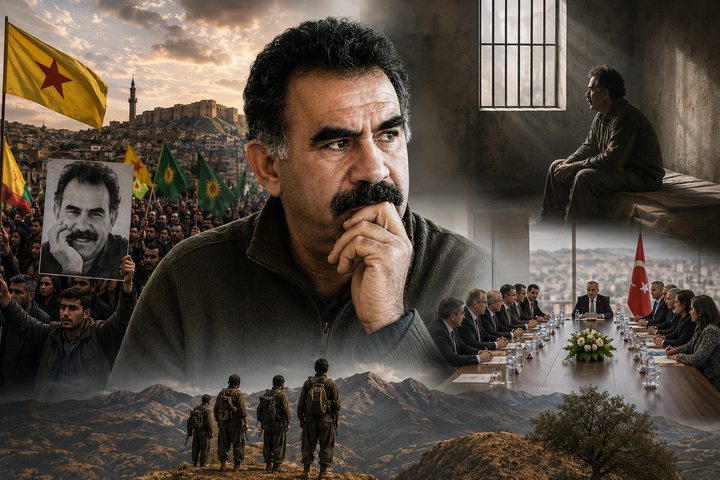
More than 27 years have passed since Abdullah Öcalan was imprisoned, but he remains the most important and influential figure in Kurdish politics. However, at the same time as the new process of dialogue between the Turkish government and the Kurdish movement began, criticism from within the Kurdish community has also been directed at the imprisoned leader of the PKK; Criticisms that accuse him of distancing himself from the ideal of independence and even aligning with the interests of the Turkish government.
The author of this article believes that such a perception, rather than a change in Ocalan's positions, is the result of an incomplete understanding of his intellectual evolution and the accumulated expectations of Kurdish society after decades of war.
According to the author, Öcalan was the leader of a classic national liberation movement in the 1980s and 1990s, which saw armed struggle as the only way to deal with the denial of Kurdish identity. But after his arrest in 1999, his thinking changed. He gradually distanced himself from the idea of forming a Kurdish nation-state and proposed the theory of "democratic confederalism"; A model based on local democracy, people's participation, gender equality, environmental protection and coexistence of different ethnic groups.
Öcalan's supporters consider this development not a retreat, but a redefinition of the struggle strategy. From their point of view, the experience of the Middle East has shown that the nation-state model has not only not solved the Kurdish problem, but has led to the reproduction of violence, and the continuation of the war will only impose more human costs on the Kurds.
However, critics say Öcalan's long isolation in prison has reduced his understanding of the realities on the ground. They believe that while the Turkish government has maintained its security and military pressures, the Kurdish movement has repeatedly made concessions for peace, without achieving stable political or constitutional guarantees.
The failure of the peace process from 2013 to 2015 and the subsequent bloody conflicts have intensified this pessimism. Many Kurds believe that experience has shown that the Turkish government seeks to maintain security control rather than real reconciliation.
The author further mentions the generational changes in the Kurdish society. The new generation, especially in Türkiye, Syria, Iraq and among the Kurdish immigrants in Europe, does not have the same view of Öcalan. Some have stronger nationalist tendencies, and some, under the influence of regional and international developments, have found a different understanding of the future of the Kurdish issue.
According to the author, social networks have also played a role in aggravating this gap. He talks about the extensive activity of Ocalan's opponents in the cyberspace to destroy his image and believes that part of today's criticism is the product of organized media campaigns.
One of the most important axes of the article is the analysis of Öcalan's different perception of developments after October 7, 2023. The author says that a part of the Kurdish nationalist currents thought that Israel and America would put pressure on Iran and then Turkey on the way to change the political structure of the Middle East, and this would be a historic opportunity for the Kurds.
But according to the author, Öcalan did not consider such an analysis to be realistic. From his point of view, the fate of the Kurdish movement should not be based on uncertain geopolitical calculations or promises of foreign powers. For this reason, he welcomed the new process of dialogue with Ankara and tried to take advantage of the created space to advance the demands of the Kurds from the political path.
The author observes the same approach towards the north and east of Syria. He believes that Ocalan was worried that the region would face a disaster similar to Gaza if Syrian Kurdish forces enter a direct and widespread confrontation. From this point of view, the restraint of Mazloum Kobani and the Syrian Democratic Forces was not a sign of weakness, but a strategic choice to preserve the political achievements of the Kurds.
In the final section, the author emphasizes that an important part of misunderstandings is due to poor communication. The strict restrictions of the prison caused Öcalan's views to be disseminated indirectly through lawyers, political boards or limited messages; An issue that has provided the context for different and sometimes contradictory interpretations.
According to the author, the main issue is no longer whether Öcalan is a "traitor" or not, but how far the Kurdish movement has been able to explain to its society how the sacrifices of the past few decades are connected to today's political strategy and what is the final destination of this path.
This article tries to answer the recent criticisms of him. The author argues that Ocalan's change in strategy is not the result of surrender, but the result of theoretical evolution and a realistic assessment of the balance of power in the Middle East. On the other hand, he admits that the failure of the peace processes, the heavy costs of the war and the lack of tangible political achievements have caused a significant part of the Kurdish society to doubt and despair about the future of this strategy. Finally, the article leaves judgment on the success or failure of Öcalan's current strategy to the future and fate of the Kurdish issue in Türkiye and the region.
Author: Dr. Sivan Saeed, a graduate of the University of Exeter, England


Your Comment