

According to Kurdpress, Murat Karayılan, a member of the People's Defense Forces (HPG) headquarters command, spoke to Sterk TV about the process initiated by Abdullah Öcalan on February 27, 2025. He stated that this process holds historical significance not only for the Kurds but also for the Republic and the State of Turkey. Noting that the Kurdish issue is one of Turkey's most deep-rooted and fundamental problems, he explained that, following Öcalan's call, their movement has proceeded based on a belief in the "strategy of democratic societal struggle" and has adopted serious decisions in this regard. Karayılan said, "We have made decisions from which there is no turning back; however, the Turkish state has not yet taken any concrete legal steps."
Pointing to the visits of government delegations to Imrali, the formation of a parliamentary commission, and the cessation of hostilities, Karayılan stated that while these measures are significant, they are insufficient to advance the process, and the Turkish government has yet to make a clear, definitive decision regarding the path to resolving the issue. He emphasized that the "issue of trust" remains a serious concern and that the government has not yet taken any steps to build confidence. According to him, by disbanding the PKK and halting the strategy of armed struggle, the Kurdish movement has signaled that—rather than hostility—it seeks to turn a new page and establish a relationship based on friendship.
He went on to criticize the Turkish government's approach to defining the current process known as "Turkey without Terrorism," stating that the Kurdish issue is a historical and social matter—and one of Turkey's most fundamental issues—that cannot be reduced to the subject of "terrorism." Karayılan added that their movement has shifted its paradigm for resolving the issue and that the Turkish government must do the same. He remarked that trust cannot be established as long as the government views the issue through its old mindset of "denial and annihilation" and perceives the Kurds as a threat.
Karayılan emphasized that their goal is reconciliation with the government, the transformation of the republic into a democratic one, and participation within it. He stated, "We do not wish to stand in opposition to this republic."
Commenting on the discussions regarding the submission of the so-called "Framework Law"—which concerns the peace process—to the Turkish parliament, an HPG commander stated that if the legislation is not unilateral and adopts an inclusive approach, it could create a historic opportunity for Turkey. Pointing to the historical background of the Kurdish issue, he noted that the matter has existed since the inception of the Turkish Republic and was evident even during the late Ottoman era. According to Karayılan, the Turkish Republic has approached the Kurdish issue with a harsher and more violence-oriented stance compared to the Ottoman Empire.
Karayılan added that the Kurds seek to be free and equal citizens within the framework of a democratic republic, and that the Republic, in turn, must embrace them. He stated that if the Turkish parliament or the drafters of the framework law adopt such an approach, a completely new era would begin in Turkey, potentially transforming the country into a center of democracy in the Middle East. He emphasized that they are waiting to see whether the law "will encompass all issues."
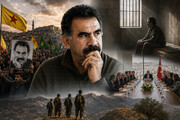
Elsewhere in his remarks, Karayılan noted that apart from the government delegation, no one has met with Abdullah Öcalan over the past 42 days, describing the situation as "political isolation." He added that while visits to Imrali should have increased at this stage, delegations—including the DEM Party delegation—have been prevented from meeting with Öcalan. Karayılan also dismissed claims that Öcalan had endorsed the draft law, characterizing them as "part of a psychological war."
According to Karayılan, had an agreement been reached, the path for meetings would have opened up, and the DEM Party delegation could have visited Imralı. He claimed that the government is attempting to impose its approach on Öcalan at Imralı, adding that such a method—coupled with continued isolation—is improper and a cause for concern.
Emphasizing that Abdullah Öcalan is the "key negotiator," Karayılan stated that the process cannot move forward without him. He added that the decisions of the 12th PKK Congress were based on the premise that the process of ending the armed struggle must be managed by Öcalan, which necessitates his physical freedom to implement those decisions. He remarked, "No path forward is possible without Öcalan. Insisting on the current situation only complicates the process."
He also emphasized that Kurds must be recognized within the legal framework, stating that if it is acknowledged that "Kurds exist" and that "Kurds and Turks are brothers," then Kurds must also hold a place within the law rather than remaining outside it. Karayılan added that only in this way can Kurds become free, democratic citizens; he warned that if legislation is merely restrictive, compartmentalized, and drafted solely with the guerrillas in mind, it will deepen the impasse rather than resolve the issue.
Karayılan went on to criticize what he termed "psychological warfare and the political exploitation of the process," noting that now that the issue is on the table and a democratic, political resolution is on the agenda, it is inappropriate to propagate exaggerated or one-sided narratives.
In conclusion, Karayılan emphasized that the decision to end the strategy of armed struggle is final and that there is no turning back from the resolutions of the 12th PKK Congress. He stated, "Our strategy is democratic politics. We are prepared to engage in a democratic political struggle within the framework of a democratic country and the rule of law." At the same time, he added that should they face an attack aimed at their annihilation, they would defend themselves; however, their primary decision and first choice remain the strategy of democratic politics and a democratic society—a vision put forward by Öcalan.



Your Comment