

According to Kurdpress, under the new U.S. strategy for West Asia, the Kurds are no longer merely a security issue or a military ally; rather, they have become part of an interconnected network linking Iraq, Syria, and Turkey. In this model, while bolstering the role of central governments, the U.S. utilizes key Kurdish parties as complementary actors to advance energy corridors, trade, and regional political management.
The Kurds' Position in the New U.S. Blueprint
Developments over the past two years indicate that Washington is implementing a new architecture for Iraq, Syria, and Turkey—one centered not on a massive U.S. military presence, but on economic integration, energy corridors, regional trade, and the devolution of security responsibilities to local allies. In this framework, Turkey is emerging as the primary gateway for energy and trade, Iraq as a hub of energy resources, and Syria as a transit route to the Mediterranean.
Amidst this, the Kurds have also assumed a new role. They are defined within this new order not as a monolithic bloc, but as a collection of distinct actors, each serving a different function.
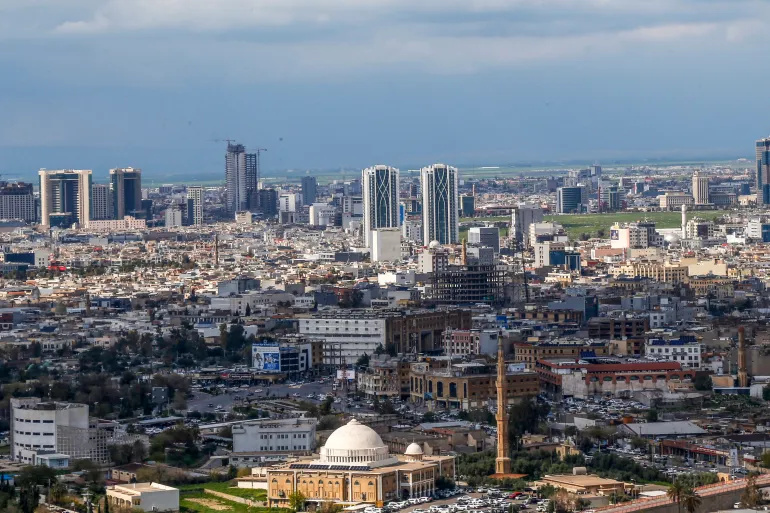
In Iraq, the United States and its regional partners distinguish between the two main Kurdish parties. The Kurdistan Democratic Party (KDP) remains a key player in the oil sector and in trade with Turkey, owing to its control over the majority of oil fields, the Ibrahim Khalil border crossing, and the oil pipeline to the port of Ceyhan.
In contrast, the Patriotic Union of Kurdistan (PUK) has gained increasing importance due to the concentration of natural gas resources in the areas under its influence. The development of the Khor Mor gas field and gas transmission projects has established the party as a cornerstone of Iraq’s new energy agenda and a key factor in reducing Baghdad’s reliance on Iranian gas.
Simultaneously, the peace process between Turkey and the PKK has altered the Patriotic Union’s position. While the party’s past closeness to the PKK was once viewed by Ankara as a threat, that same connection can now facilitate a mediating role in managing relations between the PKK, the Syrian Democratic Forces (SDF), and the Turkish government.
This shift does not imply a decline in the importance of the Democratic Party; rather, it indicates that the two Iraqi Kurdish parties have assumed distinct roles within the new order: the Democratic Party focuses on oil, trade, and ties with Turkey, while the Patriotic Union concentrates on the gas sector and the management of political issues concerning the PKK and northern Syria.
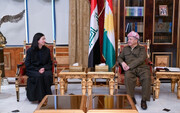
This pattern is also evident in Syria. Discussions regarding the future of Syrian Kurds have frequently taken place not in Damascus or Washington, but in Erbil and Sulaymaniyah. Meetings involving Mazloum Abdi, Masoud Barzani, Bafel Talabani, and Nechirvan Barzani—attended by U.S. Special Envoy Tom Barrack—demonstrate that the Kurdistan Region has become the primary hub for coordinating Kurdish affairs in the region.
From Washington’s perspective, the ultimate goal remains the strengthening of central governments; consequently, the U.S. emphasizes integrating the Syrian Democratic Forces into the structure of the Damascus government. Nevertheless, achieving this objective still requires Kurdish political and social networks.
Consequently, within the new U.S. framework, the Kurds play the role of a "connecting layer"—neither the central pillar of the regional order nor an actor independent of states, but rather a link connecting energy routes, trade, political negotiations, and lines of communication among Iraq, Syria, and Turkey.
This approach also explains why the prolonged impasse in forming the Kurdistan Regional Government’s cabinet has not generated significant external pressure; from the perspective of international actors, as long as oil exports, gas project development, and communication channels between Kurdish parties remain intact, the delay in forming the local government will not hinder the implementation of the broader regional strategy.
In summary, the Kurds' position within the new U.S. strategy has evolved from a mere "security issue" into a factor of geopolitical connectivity.






Your Comment