

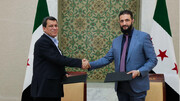
According to KurdPress, years of civil war had placed Syrian Kurds and Turkmens on opposite sides of one of the most complex conflicts in the Middle East. Forces affiliated with the two communities repeatedly faced each other on the battlefield, and the political rivalry between them was equally deep. But in Syria, after the fall of Bashar al-Assad's government, the equations are changing. Today, what brings the two sides together is not forgetting the past, but an effort to increase political influence, guarantee ethnic and cultural rights, and prevent marginalization in the new power structure in Damascus.A sign of this change can be seen in the April 2026 meeting between Sipan Hamu and Fahim Issa, two commanders who fought against each other on the fronts of northern Syria for years and who now both serve as deputy defense ministers in the new Syrian government. Hamu, a former senior commander of the People’s Protection Units (YPG) and the Syrian Democratic Forces, is in charge of the eastern regions, and Fahim Issa, a former commander of the Turkmen Sultan Murad group, oversees the northern regions. Their meeting was not just a formality, but reflected a deeper shift in relations between two societies that until recently considered each other enemies.
This change is not only visible at the level of the military elite. There are also signs of convergence of demands in the social sphere.The Kurds protested the government’s use of the official name “Ayn al-Arab” instead of “Kobani,” and almost simultaneously, the Turkmen demanded recognition of the historical name “Turkmen Bath.” Both communities now insist on preserving their linguistic, cultural, and historical identities and expect the new government to recognize these demands.
However, the path to this point has been a turbulent one. During the civil war, Syrian Turkmen largely sided with the opposition to the Assad regime and participated in many military operations against ISIS and then against the Syrian Democratic Forces, with direct Turkish support. In contrast, the bulk of Kurdish forces organized themselves into the People’s Protection Units (YPG) and then the Syrian Democratic Forces, which Turkey considers the Syrian branch of the Kurdistan Workers’ Party (PKK).The bloody battles in Aleppo, Afrin and other areas of northern Syria turned this rift into one of the deepest fault lines of the civil war.
The differences were not limited to the battlefield. In the political arena, representatives of Turkmen and Kurdish parties also disagreed for years on issues such as autonomy, the future structure of Syria and relations with Turkey. Many Turkmen leaders accused parties close to the autonomous administration in northern and eastern Syria of pursuing separatist projects, while a significant part of Kurdish movements considered Turkmen organizations closer to Ankara's policies than independent actors.
But the fall of the Assad regime has changed the priorities of both sides. Now Kurds and Turkmens face a common problem: how to gain a greater share in the new political structure of Syria and prevent the complete concentration of power in the hands of the Arab majority.This shared concern has provided the basis for dialogue and cooperation.
Turkmen leaders say they share most of their demands with the Kurds. Both communities want greater representation in government institutions, the appointment of local administrators from among the residents of their regions, guaranteed cultural and linguistic rights, effective participation in drafting a new constitution, and a change of the country’s official name from the “Syrian Arab Republic” to the “Syrian Republic.” Although the Kurds gained some of their cultural rights through a presidential decree in January 2026, the Turkmen have not yet enjoyed such a privilege, adding to the shared interests of the two sides.
Statistical facts also encourage them to cooperate.Kurds hold only 10 seats and Turkmens seven in Syria’s 210-member parliament, a capacity that alone is not enough to influence the constitutional drafting process or major political decisions. For this reason, the idea of forming a coalition between ethnic and religious minorities, from Kurds and Turkmen to Assyrians, Syriacs, Circassians and Christians, has received more attention than ever before. The Syrian Turkmen conference in Damascus, attended by representatives of these minorities, can be assessed in this context.
This trend has also been reflected in the military structure. Reports indicate that commanders of the Syrian Democratic Forces, who are being integrated into the new army, have begun talks with Turkmen officers in order to create a balance against the numerical superiority of Arab forces in the new army structure.If this trend continues, political cooperation could expand to include security and military cooperation.
Nevertheless, the prospects for such convergence remain uncertain. The memory of years of war, mutual distrust, and political rivalry still lingers. Moreover, the future of bilateral relations also depends on factors beyond Syria, including the fate of the peace process and disarmament of the PKK in Turkey, the quality of relations between Ankara and Damascus, and the implementation of the agreement to integrate the Syrian Democratic Forces into the army.
Overall, the rapprochement between the Kurds and Turkmen of Syria today should not be interpreted as the end of their historical differences. This convergence is more than anything a pragmatic response to the new balance of power in post-Assad Syria; an attempt for the country’s two major minorities, despite their tense past, to gain a more effective place in Syria’s future through political and institutional cooperation.Whether this cooperation becomes a sustainable coalition or falls apart under the pressure of domestic and regional developments will depend on the process of rebuilding Syria's political order in the coming years.

Your Comment