

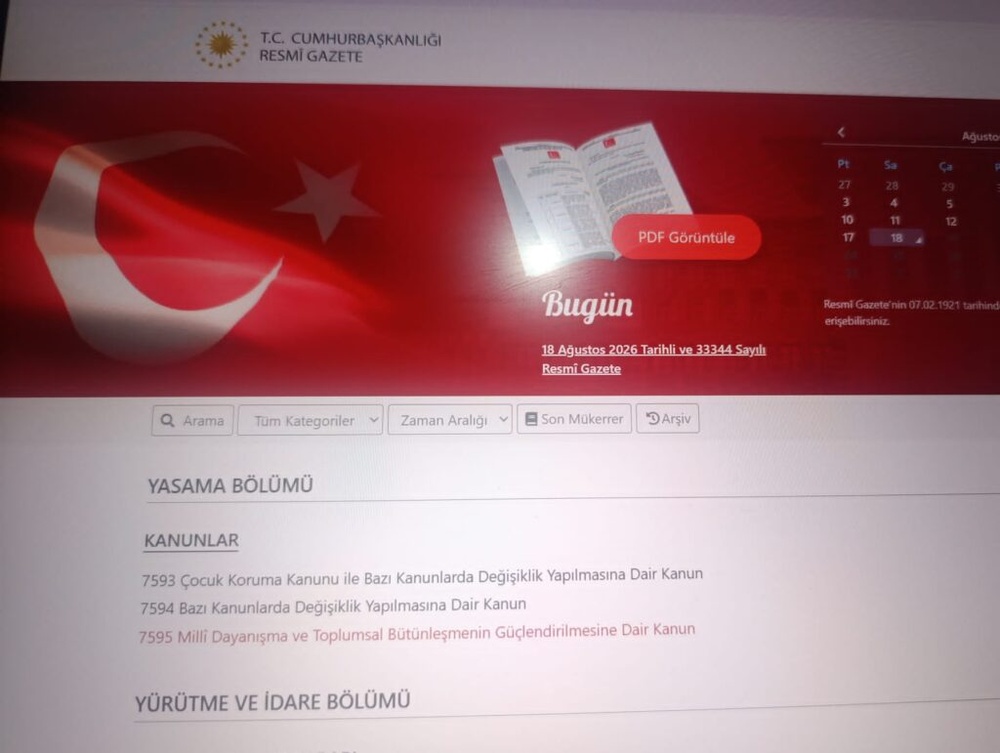
According to KurdPress, in early August 2026, the Turkish Parliament passed the "Strengthening National Solidarity and Social Integration" law, which sets the framework for the return and reintegration of PKK members into Turkish civil society. However, the activation of this law is subject to the approval of the Turkish National Security Council that the PKK, the KCK organizational complex, is a terrorist organization.The PKK and all its affiliated or related structures have laid down their weapons and entered an irreversible phase of disarmament. This confirmation will effectively mark the beginning of a six-month period for the implementation of the return mechanism and the determination of the legal status of the group’s members.
According to reports from sources close to the negotiations, the process of verifying the dissolution and disarmament of the PKK has entered an advanced stage. It is said that the National Intelligence Organization and the Turkish Armed Forces will review the process of disarmament and evacuation of the camps in August and September, and the results of this assessment will be presented to Recep Tayyip Erdogan and then the National Security Council. Based on this timeline, it is likely that the official announcement of the dissolution of the PKK will be made in October, and from that point, a six-month mechanism for the return of eligible members will begin.This process is being pursued in a situation where, according to existing reports, the majority of the PKK military structure in Iraq and Turkey is being dismantled, and the process of integrating the Syrian Democratic Forces into the Syrian government structure is also approaching its final stages. However, in the east of the Kurdistan Region, the presence and activity of some satellites and structures affiliated with the PKK continues, and reports indicate the expansion of some military infrastructure, digging tunnels and establishing new positions in the eastern regions of the region.
Within the framework that Turkish security authorities have considered to verify the dissolution of the PKK, about 3,800 armed forces of this group are present in 18 camps in the northern Kurdistan Region of Iraq. In addition, about 2,500 people who have severed their ties with the PKK but live in the region, and about 1,500 other unarmed individuals close to this movement are also present in this region.However, not all of these individuals will necessarily be covered by the new law, and it is estimated that nearly 900 armed forces, including around 230 senior figures, will remain outside the repatriation mechanism in Turkey.
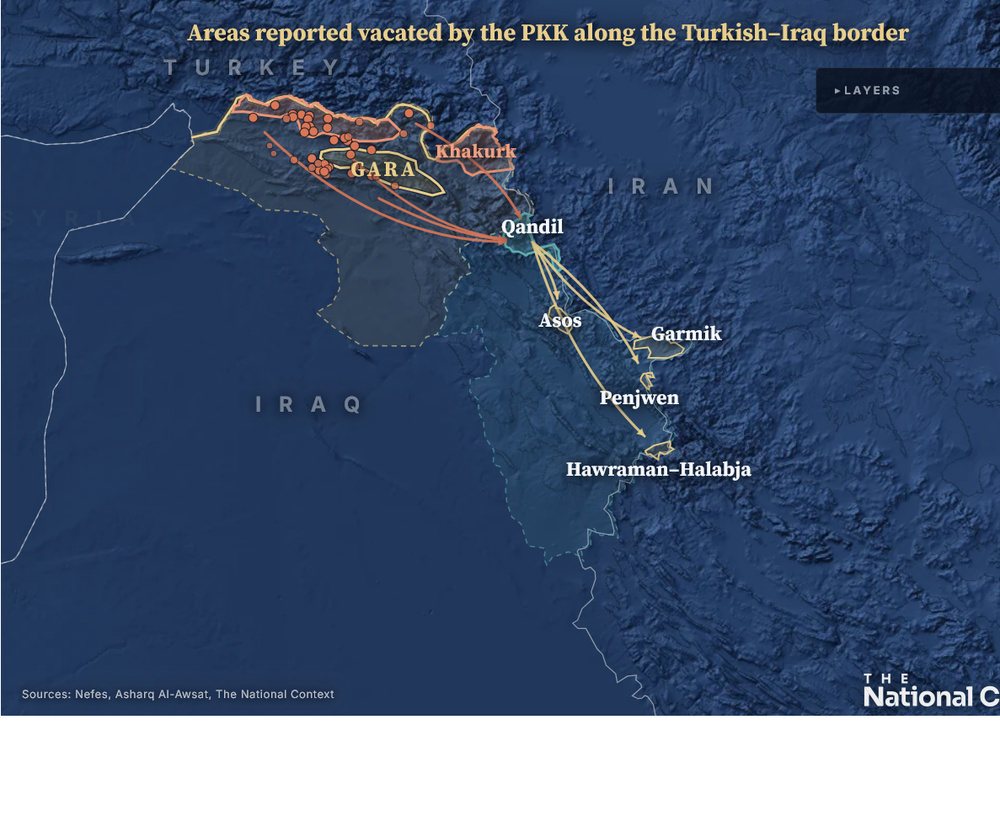
In the area of weapons handover, five main points have been identified as weapons collection areas, including Banaras Qandil, Kurtak, Zargale, Laushe and Bule. Four of these areas are located in the western part of Qandil, indicating that the weapons handover process is mainly taking place in the same traditional geography of troop deployments, rather than in remote centers. Turkish security reports also report the presence of numerous underground warehouses and a wide range of anti-armor weapons, mortars, machine guns, anti-tank missiles and air defense equipment in these warehouses.In the evacuation section, reports indicate the abandonment of dozens of positions in the Gara, Metina, Zap, Avaşin and Haftanin regions and other areas close to the Turkish border. According to these reports, some of these evacuations have been verified using field information, satellite images and situational data, and Turkish forces have been deployed in them after clearing some positions. As a result, the northern strip of the Kurdistan Region along the Turkish border is not becoming a space free of the PKK presence, but rather the process of withdrawal of forces is continuing simultaneously with the establishment of control and further deployment of Turkish forces in these areas.
In contrast, developments in the eastern part of the Kurdistan Region show that some of the PKK-affiliated networks are moving and consolidating their positions in the eastern axes, instead of leaving the region.Current estimates put the number of these structures at between one and three thousand, although it is difficult to distinguish them precisely from the main PKK forces in Qandil, and there is overlap between these networks in terms of geography, organization, and organizational history.
Field reports from the areas around Boyin near Halabja indicate the establishment of new bases, tunneling, well drilling, and the use of heavy machinery. There have also been reports of the construction of trenches, road expansion, and the movement of heavy equipment along the routes from Qandil to the areas of Asos, Bradost, Chuman, and Sediqkan, as well as along the southern routes to Panjvin, Halabja, and Huraman. The combination of these developments indicates that part of the armed structure affiliated with the PKK is shifting its geographical gravity from the northern strip of the region to the eastern regions of the Kurdistan Region.
This shift raises an important question about how to define the “complete dissolution” of the PKK.The Turkish legal framework ostensibly covers the PKK, the KCK and all of their affiliated organizations, but the practical criteria for ending the existence of each of these affiliated structures are not defined with equal clarity. This could allow for different treatment of the PKK core and some of its satellites.
From this perspective, the deployment of some of the PKK-affiliated forces and networks in the eastern Kurdistan Region can be seen as part of the organization’s transition phase; a phase in which the PKK’s main structure in Turkey and the north of the region is being dissolved and disarmed, but some of its associated human, logistical and military capacities are being reorganized in a different geography. This situation does not mean that there is a formal agreement between the regional parties, but it shows that the process of dissolving the PKK is ongoing.The dissolution of the PKK will not necessarily mean the immediate elimination of all armed structures and those affiliated with it from the geography of the Kurdistan Region.
The role of the Patriotic Union of Kurdistan in this process is also of geographical importance. A significant part of the eastern axes of the region is under the influence of this party, and the possibility of the transfer of some of the PKK forces or senior figures to areas close to Sulaymaniyah, Panjvin, Halabja and the eastern borders makes this region one of the most important points in the post-dissolution phase. However, the current report emphasizes that these developments should not be taken as a sign of a formal agreement between the regional parties; the available evidence is more indicative of a convergence of interests and a geographical division of roles.
The most important test of this process will be the decision of the Turkish National Security Council in October. If the council decides to dissolve and disarm the PKK and the KCK,declare the PKK complete and irreversible, while some of the satellites and structures associated with the PKK remain armed and have active positions, tunnels and infrastructure in the eastern Kurdistan Region, this issue will show that the post-dissolution phase of the PKK could be accompanied by the continuation of some of its military and organizational networks outside the main geography of the group's activity. In such circumstances, the main issue will shift from "Will the PKK be dissolved?" to the question of "What part of the PKK structure has been dissolved and what part continues to operate in the form of satellites and affiliated networks in the eastern Kurdistan Region?"
Source: National Context



Your Comment