

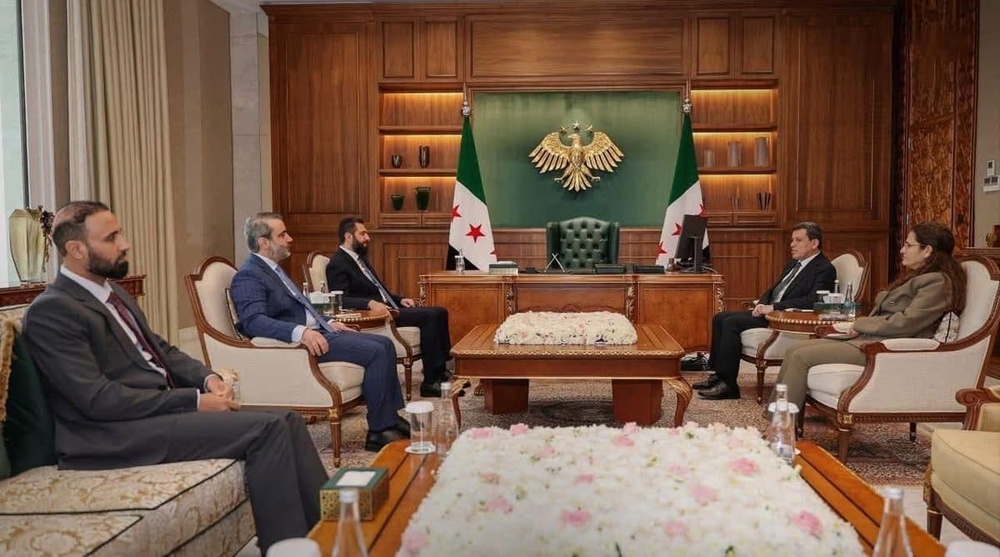
According to Kordpress, the Carnegie Foundation's new analysis of the process of rebuilding the Syrian army after the fall of Bashar al-Assad's government evaluates the agreement between Damascus and the Syrian Democratic Forces (SDF) not as a temporary agreement, but as part of a new model of governance and military organization in Syria, which is based on the gradual integration of local forces into the government structure, without their immediate elimination.
Khizr Khazour, a Carnegie Foundation researcher, in this report entitled "An army of the children of the regions; Syria's military order after Assad" writes that the transitional government of Syria led by Ahmed al-Shara, in contrast to the Assad regime, which ran the army through a fully centralized command, has been forced to rely on local networks and armed groups that have been formed during the years of war to prevent the country from collapsing.
According to the author, although this policy helps to stabilize the security situation in the short term, it can challenge the authority of the central government in the long term; Because many units of the new army will remain dependent on their commanders, social ties, and local bases.
Damascus's different model for the integration of the Syrian Democratic Forces
Carnegie emphasizes that the integration process of the Syrian Democratic Forces is different from other opposition groups. These forces have entered the new structure not through dissolution and joining the army, but based on a separate agreement with Damascus.
Based on this analysis, the Syrian Democratic Forces are supposed to be organized in the form of four military brigades in the regions of Kobani, Hasakah, Qamishli and Malikiyeh. At the same time, the management of border crossings, oil fields and some administrative institutions in the provinces of Hasakah, Raqqa and Deir Ezzor will also be handed over to the central government in stages.
The author believes that Damascus is not looking for the complete elimination of the Syrian Democratic Forces at this stage, but is trying to gradually divide these forces into smaller units and integrate them into the structure of the new army, while the local commanders will continue to maintain their role to maintain stability and maintain field control.
Kurds' experience, part of the new model of Syria
According to Khazour, the agreement model with the Syrian Democratic Forces is not an exception, but an example of the new way of organizing the Syrian army. He believes that due to military and security restrictions, the new government is forced to cooperate with local actors through negotiation and responsibility sharing.
The author even suggests that in the future, Sweida province and Druze armed groups will be integrated into the government structure with a similar mechanism; A pattern that shows that Syria is moving towards a kind of political concentration in Damascus, but decentralization in the military sphere.
Warning about the future
At the same time, the Carnegie report warns of the long-term consequences of this trend. The author argues that if the transitional period drags on and the central government fails to establish robust national institutions, local forces—such as the Syrian Democratic Forces—could become increasingly entrenched within their respective social and geographic environments, evolving into power centers that Damascus would find difficult to rein in.
By comparing the situation in Syria with the experiences of Lebanon and Iraq, the report concludes that the formal integration of armed groups into state structures does not necessarily signify the end of their independent influence. From the perspective of the Carnegie Foundation, the primary challenge facing the new Syrian state is no longer merely the formation of a unified army, but the creation of a government capable of asserting sovereignty over forces that remain deeply rooted in their own local, ethnic, and social structures.


Your Comment