

According to Kurdpress, a specialized workshop held at the Free University of Brussels (VUB), attended by a number of researchers specializing in Kurdish issues, examined the peace process between the Turkish government and the PKK, as well as the emerging concept of "democratic integration" within Abdullah Öcalan's thought. Analyzing recent developments in Turkey and Syria, participants debated whether "democratic integration" serves as a tactic to avert the destruction of the Kurdish movement or constitutes part of Öcalan's long-term strategy for realizing a democratic society.
These discussions are presented in an article titled "Democratic Integration or Destruction?" The article is based on a workshop titled "A Nameless Process: War, Negotiation, and Peace in Kurdistan," organized by Jan-Yasin Sonçağ and Joost Jongerden at the Free University of Brussels on June 8 and 9.
According to this article, the view is held that the Kurdish liberation movement has reached one of the most critical junctures in its history. It is believed that the shifting military balance in favor of the Turkish state, the expanded use of modern technologies—particularly drones—mounting pressure on the Autonomous Administration of North and East Syria, and regional geopolitical developments have posed a serious challenge to the continuation of the classic model of armed struggle.
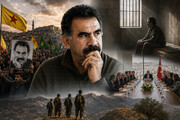
The argument is made that Öcalan views the peace process not merely as a means to end the war, but primarily as a strategy to safeguard the very existence of Kurdish society. In a landscape where states monopolize advanced warfare technologies and operations against guerrilla forces are conducted with greater precision and lower costs, persisting with military conflict could lead to an escalation of violence and potentially even the destruction of the Kurdish movement.
Öcalan warns of the risk that the Middle East could face a "Gaza-like" scenario. Observers note his concern that the region's ethnic and religious minorities—including the Kurds—could be subjected to devastating wars or even mass annihilation. Consequently, he views efforts to open a path for negotiation and de-escalation as a prerequisite for the survival of Kurdish society.
The article also addresses developments in northern and eastern Syria, asserting that pressure on the Autonomous Administration of North and East Syria mounted following agreements reached by regional and international powers. Nevertheless, Öcalan’s consultations played a role in forging an agreement between the Syrian Democratic Forces and the Damascus government, thereby preventing the total collapse of the autonomous structure—even though significant political and military gains made by Rojava have been curtailed.
The authors believe that the attribute "democratic" is fundamental to this theory. Öcalan defines the administration of society based on councils, communes, local assemblies, and democratic municipalities, maintaining that political power should be organized from the bottom up rather than centralized within the state. Within this framework, "democratic integration" is viewed as part of his broader project to realize a "democratic republic" and "democratic confederalism."
At the same time, the researchers do not refrain from critiquing the performance of the Kurdish movement in Syria. They argue that, despite significant achievements, the self-administration experience failed to sufficiently expand public participation and social organization in certain areas; consequently, it is now essential for the Kurdish movement to focus more than ever on strengthening political consciousness and grassroots institutions.
These views drew a response from two researchers present at the workshop. Jan Jassin Sonja argues that "democratic integration" should not be viewed merely as a political tactic; rather, the concept represents a logical progression in the evolution of Öcalan’s thought—moving from "democratic republic" and "democratic confederalism" to a new stage. According to him, preventing the destruction of Kurdish society is an independent and fundamental goal that cannot be dismissed as merely a tool for advancing a political tactic.
Emphasizing the historical context of this approach, Joost Jongerden notes that Öcalan’s efforts to find a political solution are not limited to recent developments. He points out that, since the 1990s, the PKK has repeatedly declared ceasefires, dispatched peace delegations, and consistently endeavored to create the necessary space for legal political activity.
In their rejoinder, the article’s authors—Jihad Hammi and Thomas Jeffrey Miley—emphasize that the disagreement between them and their critics stems less from substantive differences than from differing definitions of "tactics" and "strategy." They clarify that "democratic integration" pursues a dual objective: preventing the destruction of Kurdish society while simultaneously laying the groundwork for a democratic, self-organized society within the framework of existing states.
In summarizing the discussion, the participants reached a consensus that the future of the peace process depends, above all, on the level of societal organization, the expansion of grassroots institutions, and the Kurdish movement's ability to shift the struggle from the military to the political arena.

Your Comment