

According to KurdPress, Mustafa Karasu, a member of the KCK Executive Council, offered his assessment of developments in Kurdistan, Turkey, and the Middle East, as well as the "peace and democratic society" process, in an interview with Medya Haber.
Noting that the current peace process was initiated by Abdullah Öcalan, Karasu stated that this issue is not merely a matter for a political movement but concerns the future and freedom of an entire nation. Referencing Öcalan’s call on February 27, 2025, he said: "The peace process and the democratic society are currently advancing through the leadership's initiative. In his February 27 call, the leader outlined his approach in a concise manner, yet we have not yet achieved the desired outcome."
Criticizing the Turkish government's stance, he added that despite some visits to Imrali and the exchange of messages, the process has not yet led to concrete, practical steps. Karasu said: "Yes, the isolation imposed on the Leader has eased somewhat; certain delegations have visited, and messages have been exchanged—we sent some and received others from the Leader—but these interactions have not yet translated the process into tangible steps."
**Lack of Access to Öcalan Is a Serious Issue**
Referring to discussions surrounding the peace process bill known as the "Framework Law," Karasu noted that there is considerable ambiguity and confusion regarding the matter. He stated that Abdullah Öcalan had worked on drafting such a law and submitted a proposal to the Turkish government on May 24, yet there have been no meetings with him since that time.
He remarked: "There has been no meeting with the Leader since May 24. Is such a thing even possible? This situation alone demonstrates a lack of seriousness and an improper approach to the process."
Karasu added that the government was supposed to review the draft, take it back to Öcalan, and keep the KCK informed, but this process did not take place. He stated: "We have no knowledge of any agreement or understanding reached with the leadership. The DEM Party has also announced that it is unaware of any such development. The issue that concerns us most is being discussed in various ways in the Turkish media, yet we have no clear information."
The Kurdish issue is not merely about the arrival or non-arrival of PKK forces.
Criticizing the reductionist view of the peace process, Mustafa Karasu said that if the matter is limited solely to disarmament or the movement of forces, no solution will emerge. He emphasized: "Viewing the issue merely as a question of who is coming or not coming amounts to failing to present a project for a solution." "If the issue is reduced merely to disarmament, how can the people, the organization, and the fighters possibly accept it?"
He stated that such an issue can only be resolved through social support, political consensus, and the participation of the key parties, adding: "This process cannot move forward with a 'I did it, and that’s that' attitude. You cannot simply say, 'I have passed the law, so accept it or not.'"
Karasu also viewed the postponement of the potential legislation until after the NATO summit as a significant and concerning matter. He remarked: "They say it will happen after the NATO summit. What does that mean? Does it mean that if they secure support from NATO and its members, there will no longer be a need for this process or for resolving the Kurdish issue, and the war will simply resume?" We made a strategic shift, not a tactical one.
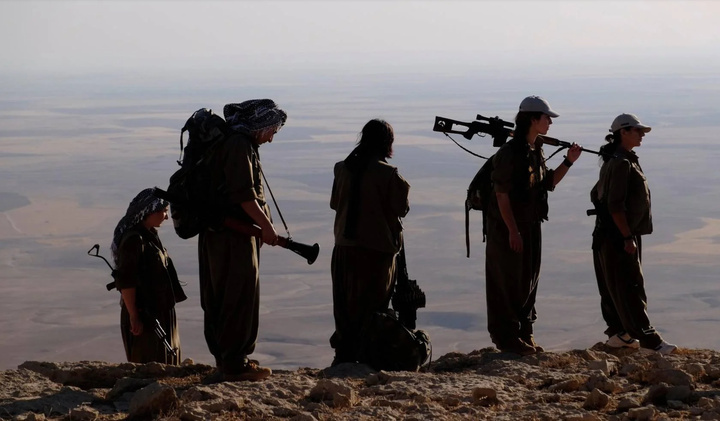
Responding to a question about the weapon-burning ceremony held on July 11 of last year—led by Bese Hozat and a group of 30 guerrillas—Qarasu stated that the action was taken to demonstrate the movement's resolve regarding the resolution of the issue. He added, "We wanted to convey our determination and our intent. That is why the group, under Bese Hozat’s leadership, carried out the act of burning the weapons."
He noted that following this move, they had expected the process to accelerate and the Turkish government to take practical steps toward a resolution, but that did not happen. Qarasu added that, subsequently, armed forces withdrew from Turkish Kurdistan, and troops were pulled back in certain conflict zones to prevent the outbreak of hostilities.
Emphasizing that these decisions were not merely tactical, he said: "We genuinely want to resolve this issue; we are not playing tactical games. We have changed our strategy. We have moved away from popular struggle waged through armed guerrillas and have instead opted for the path of democratic politics. This is a strategic shift, not a tactic."
**PKK’s burning of weapons met with no response**
Criticizing the Turkish government, Karasu noted that despite the party's dissolution, the destruction of weapons, and the demonstration of a clear will to resolve the issue, the government failed to provide an appropriate response. He stated: "Even though we undertook such a transformation—dissolving the party, burning the weapons, and openly demonstrating our resolve—we did not receive the necessary response."
Resolving the Kurdish issue is impossible without Öcalan's freedom.
Mustafa Karasu went on to say that the Turkish state and government do not wish to grasp the true nature of the issue, treating the process instead in a casual and superficial manner. He emphasized: "As long as Öcalan is not free, alive, and active, resolving this issue is impossible."
He added that if a solution is to be reached, Abdullah Öcalan—as the primary interlocutor and negotiator—must have the opportunity to work, engage in dialogue, and communicate freely. Karasu stated: "Is this issue to be resolved while the PKK leadership remains held captive and as a hostage there? That is not possible. If a resolution is to be achieved, the interlocutor—our chief negotiator and the embodiment of the people's negotiating will—must be free and in a position to work and be active."
He stated that any law failing to address Öcalan’s status and his freedom would be meaningless for resolving the issue: "What meaning would a law have if it does not encompass the leadership, bear no relation to the leadership, and fail to address the leadership's freedom?"
**It is impossible to speak of resolving the Kurdish issue in such an atmosphere**
In another part of his remarks, Karasu said that if individuals are to return or engage in political activity, the conditions for free democratic politics must be established. He emphasized that a democratic society is an organized society, adding: "For a society to be democratic, it must be organized. There must be those who organize society, and the people must be able to respond to the government's shortcomings."
Being Kurdish remains illegal in Turkey!
Mustafa Karasu identified the legal recognition of the Kurds' existence as a key element in resolving the issue, stating: "The most critical issue is that the status of the Kurd is illegal. The leadership has also stated this. The Kurd must be brought within the legal framework; the existence of the Kurd must be recognized."
He added: "Yes, in practice, people speak of Kurds, but in legal, political, and constitutional terms, the Kurd does not exist. There is no such thing. The Kurd stands outside the law."
Karasu emphasized that while legislative changes might not solve every problem overnight, they are essential for fostering a mindset geared toward resolution. He remarked: "If laws are enacted to pave the way, not every issue may be resolved immediately, but the mindset for a solution must be established."

Your Comment