

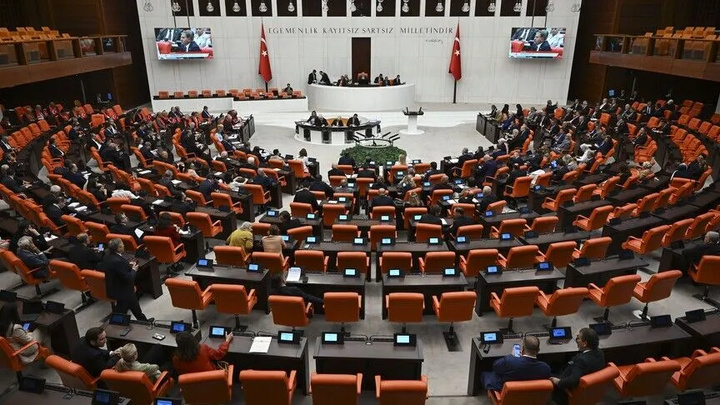
According to Kurdistan Press, with the commencement of the first term of the Syrian People's Assembly and the formation of the Supreme Constitutional Court, the Syrian transitional government has introduced these developments as a sign of the beginning of a new phase of state and institution-building. However, an examination of the political and legal structure formed after the fall of Bashar al-Assad's government shows that the political transition process has led to the concentration of powers in the presidential institution, rather than leading to the distribution of power among various institutions; an issue that some observers describe as "authoritarian consolidation of power."According to the interim constitutional declaration issued in March 2025, the president has broad powers. He has the power to appoint and dismiss ministers, personally appoint members of the Supreme Constitutional Court, submit bills to parliament, veto passed laws, issue decrees, and propose constitutional amendments. In contrast, the People’s Assembly, while able to question ministers, lacks effective tools to oversee the government or vote no confidence in the cabinet. On the other hand, given the mechanism for electing members of the assembly, the president also has significant influence over the composition of the body, which critics say has tilted the balance of power in favor of the executive branch.In his first speech to the parliament, Ahmed al-Shara described the institution as a step towards “council”, accountability and the rule of law, but the emphasis on the concept of “council” rather than “democracy” is seen by many analysts as reflecting a model in which there is consultation but final decision-making remains with the president. This perception was reinforced when the newly elected speaker of the parliament also spoke of full cooperation with the executive branch, statements that, given the parliament’s limited powers, have raised questions about the institution’s true independence. The situation is not much different in the judiciary, as all judges of the Supreme Constitutional Court are directly appointed by the president, a move that some human rights groups have seen as a dependency of the country’s highest judicial authority on the executive branch.The concentration of power is not limited to the political sphere. Provincial governors are also not elected and are appointed by the central government. In addition, the transitional government has in recent months established a series of economic, financial, and executive institutions through presidential decrees; institutions that, although enjoying administrative and financial independence, operate directly under the president. Meanwhile, some of the functions that, according to the constitutional declaration, should fall within the competence of parliament or the judiciary have been implemented through executive decisions and decrees, a trend that critics see as a sign of the president’s expanding influence in the government structure.
This pattern is also visible in the security sector.Although the armed opposition groups were formally integrated into the new Syrian army in January 2025, many of the former command structures were retained, and a significant portion of the senior commanders of the Ministry of Defense are former members of the Tahrir al-Sham and the Syrian Salvation Government. The Transitional Justice Commission, established by presidential decree, is only tasked with investigating crimes committed by the former government and does not have the authority to investigate violations committed by other actors during the war or the transition period, raising concerns about the independence and comprehensiveness of the transitional justice process.
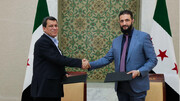
The transitional government has also taken steps towards ethnic and religious minorities, including recognizing some of the cultural and linguistic rights of the Kurds and appointing a former commander of the Syrian Democratic Forces to the Ministry of Defense.However, many analysts believe that these measures are more symbolic than leading to real participation of minorities in the power structure. According to published statistics, out of 46 senior government officials, only four are from ethnic or religious minorities, while 23 have a history of serving in the Tahrir al-Sham or the Syrian Salvation Government, a statistic that critics say indicates the continued concentration of power in a narrow political core.
The transitional government insists that this structure is a temporary stage in the reconstruction of the country and paving the way for free elections in the future.However, human rights organizations and a number of scholars warn that if legislative and judicial institutions do not achieve real independence and oversight and accountability mechanisms are not strengthened, the political transition process may lead to the reproduction of the legacy of authoritarianism in a new form, rather than moving away from it. In such circumstances, the most important question facing Syria is whether the current concentration of power is merely a temporary solution to get through the transition period or will it become a permanent feature of the country’s future political system.
Amarji Journal

Your Comment