

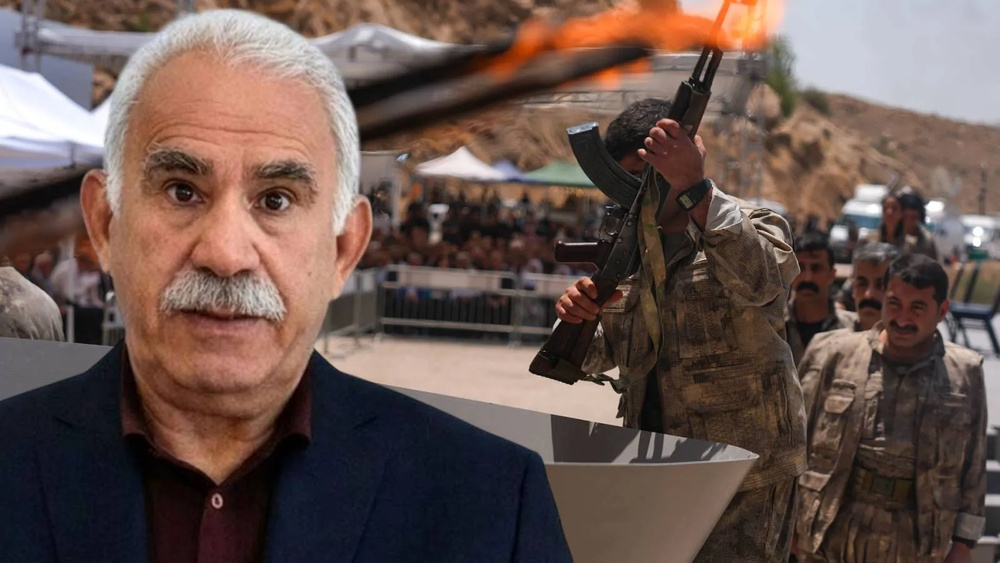
According to KurdPress, the congratulatory message from Abdullah Ocalan, the imprisoned leader of the Kurdistan Workers' Party of Turkey (PKK), to the editorial board of the Cominal magazine on the occasion of the publication of its first issue can be considered the theoretical framework of the new phase that the Kurdish movement in Turkish Kurdistan has entered; a phase that Ocalan himself refers to as "peace and democratic society."The publication "Cominal" has replaced "Serkhubun", which since 1978 has been the main platform of the Kurdish movement, publishing the views, theories and analyses of the leadership of this movement on political, social and military developments and its relationship with the Turkish state. Now, with the end of its publication, "Cominal" has been given the mission to reflect the discourse of the new stage; a stage that began after Öcalan's historic message in February 2025.
Öcalan emphasizes in his message that the new media should not remain at the level of purely theoretical discussions, but should become a living and dynamic media that can answer the questions of the Kurdish community about the nature of this new era. In his view, the media should be in direct interaction with society and the current debates in it, move with the speed of the changes of the times and distance themselves from repeating abstract discussions.
Öcalan calls for a language that is not limited to the production of theory, but that can chart the course of action, explain the stages of social organization, and provide practical solutions. For him, the stage of “peace and democratic society” is, above all, a stage of social organization; a stage in which the “commune” must be formed as the basic unit of social organization, and society must be prepared for conscious participation in politics, understanding new conditions, and achieving social empowerment.
The goal of this process is to transform Kurdish society into an influential force in political decision-making, both in Kurdistan and Turkey and beyond.
In addition to this mission, Öcalan defines another task for the “Communal”: the rereading and analysis of Kurdish history. From his perspective, this rereading should lead to the formation of a “new Kurd”; a person who has overcome a past full of tragedy, oppression, and genocide and who can now, by looking critically at his own history, build a new personality based on half a century of struggle and sacrifice; a personality who is no longer the subject of others’ politics, but who himself becomes an activist and a determinant.
Öcalan describes the past stage of the struggle as the period of saving the Kurds from “cultural genocide.” In his opinion, the young Kurdish generation and the revolutionary forces of Turkey during that period did not allow the policies of identity denial and national identification to turn the Kurdish society into a silent and lifeless society. By reviving the spirit of resistance, they re-exhibited the existence of the Kurds and showed that the Kurdish struggle is still alive.
Öcalan writes in part of his message: "The Kominal magazine, which began its publication at such a historical stage, has emphasized its determination to fulfill these tasks with its name. Therefore, it should not be considered simply as a periodical, but should be the voice of the social, political and intellectual construction of the new era and play a guiding and guiding role. Although it is important to establish a solid theoretical framework, the needs of the new stage require that the main focus be on the practical organization of society. This stage is the stage of social organization and requires collective cooperation in construction projects based on the philosophy of social organization.A media policy that focuses on the self-organization of the people, councils, cooperatives, women's and youth organizations, and moral and cultural reconstruction will represent the spirit of the new stage, because a democratic society is formed and sustained only through organized relations in everyday life. Therefore, in addition to theoretical depth, special attention should be paid to the practical experiences of organization, methods and paths of its development.”
Accordingly, Öcalan does not see the role of “communal” as simply a news or theoretical medium, but rather as a tool for guiding society towards organization, political participation and the expansion of national and democratic consciousness; a medium that should transform the Kurdish citizen into a conscious activist and, at the same time, spread the culture of participation and organization among all ethnic groups and groups living in Kurdistan and Turkey.
German Center for Kurdish Studies




Your Comment