

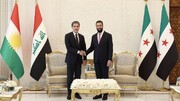
According to KurdPress, the visit of Nechirvan Barzani, President of the Iraqi Kurdistan Region, to Damascus on August 3, 2026, took place in a situation where relations between Damascus and Erbil, the process of integrating the Syrian Democratic Forces into the structure of the Syrian government, as well as security developments in the region, are at a critical stage. According to the Enab Baladi publication, this trip, which was Barzani's first trip to Syria after the formation of the country's new government, is not considered merely a diplomatic meeting between the two sides and encompasses a set of security, economic, geographical, and Kurdish considerations.Barzani met with Syrian President Ahmed al-Sharaa at the People's Palace in Damascus. According to a statement from the Syrian presidency, the two sides discussed bilateral relations, ways to expand economic cooperation, regional developments and common issues aimed at strengthening security, stability and regional cooperation.
Al-Sharaa stressed after the meeting that strengthening relations between Syria and the Kurdistan Region of Iraq and expanding areas of cooperation between the two sides are important for the interests of both sides and increasing regional security and stability. He also praised the Kurdistan Region's experience in various fields and stressed the need to continue cooperation based on good neighborly relations and historical ties. Barzani also said that Syria, Iraq and the Kurdistan Region have many common interests and that there are significant opportunities to develop economic cooperation between them.
However, the significance of this visit goes beyond official relations between Damascus and Erbil.According to Wael Alwan, a researcher at the Center for Bold Studies, the Kurdistan Region has important reasons to deepen its relations with the Syrian government in the current situation. The gradual withdrawal of the United States from the region and the continuous attacks on the Kurdistan Region during the US-Iranian conflicts have increased the need for the region to increase security and defense coordination between Erbil and other regional actors.
From this perspective, Erbil's proximity to Damascus can also carry a message to allies and supporters of the new Syrian government. The Kurdistan Region is trying to show that it supports the process of establishing the new Syrian government and considers the stability of Syria to be part of the broader stability of the region. For Damascus, proximity to Erbil is also important; especially since the leadership of the Kurdistan Region has close historical relations with Turkey, and Ankara has also expanded its relations with Damascus in the new period.Another factor that increases the importance of bilateral relations is the issue of the Syrian Kurds. The Iraqi Kurdistan Region has hosted a significant number of Syrian refugees during the years of the Syrian war and is also affected by developments related to the Syrian Kurds. Therefore, the issue of opening a Syrian consulate in Erbil, coordinating the return of refugees and cooperating in the fight against ISIS could be part of the long-term agenda of bilateral relations.
In addition to security issues, geography is also a determining factor in the proximity of Damascus and Erbil. Syria, Iraq and the Kurdistan Region are located in an interconnected geographical and economic space, and the border crossings between them could become important trade routes in the future.On the other hand, the possibility of using Syrian ports to export oil from the Kurdistan Region, if the political and technical conditions are met, could become a potential area of economic cooperation. Family and social ties between Syrian Kurds and Kurdistan Kurds have also made developments on both sides of the border important to Erbil.
But one of the most important issues that connects Barzani’s visit to the current developments in Syria is the agreement between Damascus and the Syrian Democratic Forces. The January 29 agreement to integrate military and civilian structures under the control of the SDF into Syrian government institutions has faced disputes and delays in recent months, and efforts to finalize it were intensifying at the time of Barzani’s visit.Although the Syrian presidency’s official statement did not directly mention the agreement, Dilshad Shahab, a spokesman for the Kurdistan Regional Government, announced that Barzani would discuss the Damascus-SDF agreement in addition to extensive negotiations with Syrian officials. According to him, the Kurdistan Region could still play a facilitating role in implementing the agreement, although it considers the issue of SDF integration to be an internal Syrian issue.
The AFP report, citing two official Syrian sources, also indicated that the implementation of the agreement to integrate Kurdish institutions into the Syrian government structure was one of the main topics of the meeting between Barzani and al-Sharaa. This doubles the importance of the trip, as Erbil has tried to play a mediating and facilitating role between Damascus and the Syrian Kurdish forces in recent months.Tariq Hamo, a researcher at the Center for Kurdish Studies, believes that the Kurdistan Region has been interested from the beginning in having Syrian Kurds accept dialogue with Damascus and participate within the framework of Syrian government institutions. In his view, the Kurdistan Region’s experience in Iraq can be a model for Kurdish political and administrative participation in the Syrian government, although there are fundamental differences between the two situations.
The Iraqi Kurdistan Region has its own autonomous structure, government, flag, and security forces, while the Damascus-SDF agreement, if fully implemented, will lead to the integration of Kurdish autonomous forces and institutions into the structure of the central Syrian government. Erbil’s role in this process is therefore more of a facilitating and political one than a transferable institutional model.Hamo also believes that the leaders of the Kurdistan Region have intervened at various points between the SDF and Damascus and have played a role in bringing the two sides closer together, even if this role has not been directly stated in official statements. From this perspective, Barzani’s visit can be seen as part of Erbil’s effort to help the Damascus-SDF negotiations move beyond the remaining differences.
The importance of this role increases when we place Barzani’s visit alongside his meeting with al-Sharaa and then the Syrian president’s meeting with Mazloum Abdi. Al-Sharaa’s and Abdi’s meeting took place the day after Barzani’s visit, at a time when reports had been circulating that the integration process was approaching its final stages. For this reason, Barzani’s visit can be seen as part of a broader political movement to resolve the remaining issues between Damascus and the Syrian Kurdish forces.Alwan also emphasized Erbil’s role in accelerating the implementation of the agreement and believes that Damascus needs regional pressure and mediation to overcome the current impasse. In his view, ending independent military structures and integrating them into the Syrian government has common security interests for Damascus and Erbil.
In the same context, regional developments have also affected the calculations of both sides. The escalation of tensions between the United States and Iran and attacks by Iraqi forces on targets in the Kurdistan Region, in addition to the security threats in Syria and Iraq, have changed the environment surrounding Damascus and Erbil. Both sides, despite being exposed to threats, have tried not to directly engage in these conflicts.
In Alwan’s view, the new regional conditions have increased the need for increased security coordination between the countries in the region.He believes that in such circumstances, the Kurdistan Region needs to deepen its relations with Turkey and Syria more than ever, and security cooperation with Damascus can have significant practical effects.
Finally, Nechirvan Barzani’s trip can be analyzed at the intersection of three main trends: first, the Kurdistan Region’s efforts to adapt to geopolitical changes resulting from the decline of the US presence and increased security pressures in the region; second, Damascus’ efforts to stabilize the new government and expand relations with its neighbors; and third, the effort to determine the future of Kurdish structures in northern and eastern Syria.
In the meantime, “geographical determinism” is also a factor that cannot be ignored. Syria, Iraq, and the Kurdistan Region are not only connected to each other through common borders and trade routes, but political and security developments in each directly affect the other.The refugee issue, border security, the fight against ISIS, energy transfers, trade, and the future of the Syrian Kurds have created a set of common issues that limit the possibility of Damascus and Erbil completely distancing themselves from each other.
From this perspective, Barzani’s visit is more than a ceremonial visit, it is a sign of Erbil’s efforts to redefine its place in the new regional order and at the same time play a role in shaping the political order after the Syrian war. For Damascus, too, approaching the Kurdistan Region could be a channel for communication with one of the most important Kurdish actors in the region and a tool for advancing the SDF integration process and managing the Kurdish consequences of the Syrian developments.


Your Comment