

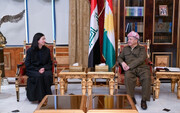
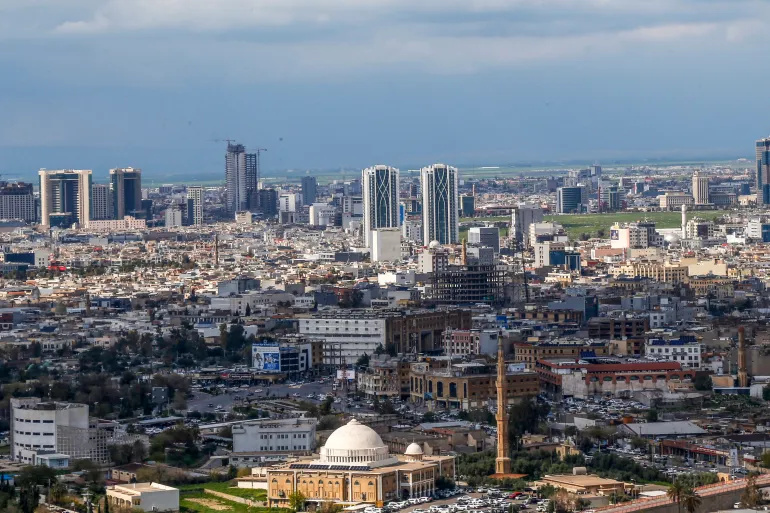
According to Kordpress, while it was thought that Thomas Barak's mission as the special representative of the United States of America for Syria affairs was over, the developments of the last two days showed that not only his role in Washington's Middle East policy has not decreased, but also expanded. After US Secretary of State Marco Rubio announced the end of Barak's mission in the Syria case, US President Donald Trump announced that he will take responsibility for the Iraq case in addition to Syria as the president's special representative.
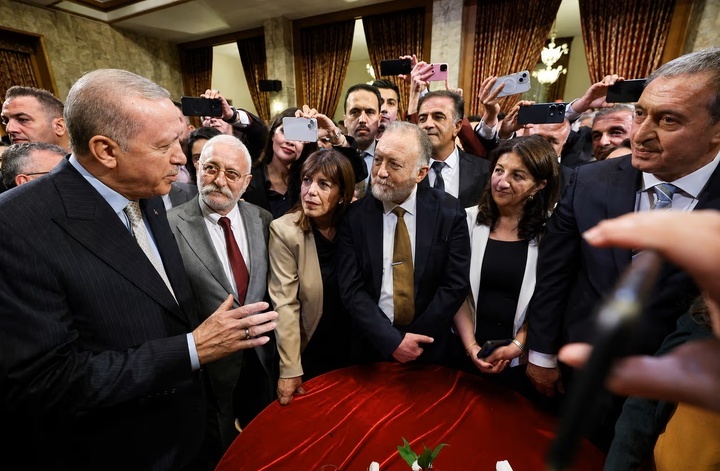
This decision shows how much the Trump administration trusts Barak and his special position in Washington's regional strategies. Barak, who is also the US ambassador to Türkiye, has now become one of the most important influential figures of the US in the three important cases of Türkiye, Syria and Iraq.
Thomas Barak; Billionaire businessman at the heart of Middle East politics
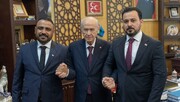
"Thomas Joseph Barak", an American investor and businessman with Lebanese roots, is one of the well-known figures in the world of investment and real estate in the United States. During decades of economic activity, he has acquired a fortune of several billion dollars, and at the same time, he is one of the closest friends and political allies of Donald Trump for more than four decades.
Barak played an important role during Trump's election campaign in 2016, and since then he has been known as one of the trusted people of the American president. Unlike many professional diplomats, he entered the field of foreign policy from business, and his most important advantage is direct access to Trump and extensive personal relationships with regional leaders.
These characteristics have caused the Trump administration to use Barak as a key player in many Middle Eastern cases instead of relying on traditional diplomatic mechanisms.
Barak's strategy in Syria
Barak's policy in Syria was based on three main axes: removing Damascus from international isolation, reducing the pressure of American sanctions and accelerating the process of normalizing Syria's relations with the countries of the region.
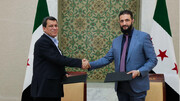
During his mission, he was one of the main supporters of the efforts to restore the transitional government of Ahmad al-Shara to the arena of international interactions. Barak also made extensive diplomatic efforts to reduce economic restrictions and encourage Western countries to resume relations with Damascus.
However, critics believe that this policy in practice caused Washington to adopt a passive position regarding some cases of human rights violations and violent encounters against various groups in Syria. According to them, the main priority of America in this period is to support the stability of the transitional government, and this issue has caused some internal crises to be ignored.
Alevi crisis and criticism of Washington's silence
One of the most important challenges during Barak's tenure was the bloody incidents in the coastal areas of Syria. Since March 2025, numerous reports have been published about conflicts and violence in the provinces of Latakia, Tartus, Hama and some areas of Homs.
Human rights groups and international organizations have reported cases of field executions and killing of civilians, including women and children. Although the US government condemned these actions, critics believe that Washington did not take any effective action to increase pressure on Damascus.
Some representatives of the Syrian Alawite community evaluated this approach as ignoring humanitarian crises in exchange for maintaining political stability.
Suwayda crisis and concerns of the Druze community
The conflicts in Sweida province were also among the other controversial cases during Barak's mission. Hundreds of Druze civilians lost their lives during the widespread tensions in the region, and there were reports of extrajudicial executions and serious human rights violations.
Although Barak made efforts to prevent the spread of the crisis and prevent a direct confrontation between Syria and Israel, many activists and leaders of the Druze community considered these measures insufficient and accused the US of neglecting the safety of civilians.
The case of the Kurds; Unsuccessful mediation
One of the most important points of criticism of Barak's performance was the way of managing the relations between the interim government of Syria and the self-governing administration of North and East Syria.
Despite the agreements signed between the two sides, clashes and tensions continued in various areas, including Sheikh Maqsood and Ashrafieh in Aleppo. Further, the scope of tensions spread to other areas of the north and east of Syria, including Deir ez-Zor, Raqqa, Taqa, Deir Hafer, Kobani and around the Tishrin Dam.
Critics believe that Barak has always supported the integration of Kurdish forces into the structure of the central Syrian government, but on the other hand, he failed to provide the necessary guarantees about the political and military security of the Kurds. As a result, many US-brokered cease-fire agreements were not implemented.
The presence of foreign forces and security concerns
Another controversial issue of this period was the presence of some former elements of extremist groups in the government and security structures of Syria. There were reports about the employment of people with records of membership in groups such as al-Qaeda, Jabhat al-Nusra, and ISIS in official institutions.
This issue provoked widespread criticism about the contradiction between the slogans of fighting terrorism and the practical performance of international actors in Syria.
The return of ISIS; A threat again
Simultaneously with the political developments, several reports of increased activity of ISIS cells in parts of Syria were published. Security sources reported the reconstruction of this group's networks and increased attacks against military forces and civilians.
This trend has raised concerns about the gradual return of ISIS to the Syrian security scene and raised questions about the effectiveness of the security policies of the interim government and its international allies.
economic crisis; Unfulfilled promises
Although supporters of the policy of normalizing relations with Syria expected this process to lead to an improvement in economic conditions, economic indicators still show an unfavorable situation.
Unemployment, poverty, lack of public services and crises related to electricity, water and fuel are still among the most important problems of Syrian citizens. Millions of people still depend on humanitarian aid to meet their basic needs.
At the same time, some opponents of the interim government believe that the new political structure has moved in the direction of greater concentration of power instead of moving towards broad political participation.
A controversial legacy
Thomas Barak's tenure in Syria was accompanied by important changes; From the relative reduction of the international isolation of Damascus and the facilitation of the process of normalization of regional relations to the continuation of security crises, ethnic and religious tensions, challenges related to the Kurds, concern about the return of ISIS and deep economic problems.
Barak's supporters consider him a diplomat who was able to bring Syria back to regional and international equations. On the contrary, critics believe that in order to fulfill Washington's geopolitical goals, he remained silent against many human rights violations and democratic demands.
Now, by handing over the Iraq case to Barack, it seems that his role in the Trump administration's Middle East policy is not only not over, but has entered a new phase; A stage whose consequences will continue to be debated in the coming years.



Your Comment