

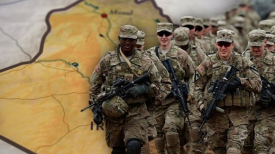
According to Kurdpress, the recent visit of Mazloum Abdi (Kobani), the commander of the Syrian Democratic Forces (SDF), to France and Italy once again demonstrated the political support of some European countries for the Syrian Kurds, but the realities on the ground show that Europe lacks the necessary tools to influence the equations in northern Syria. In a situation where America has ended its military presence and Turkey has extensive security and military influence in the region, Europe's role is more than anything limited to political mediation and diplomatic support.
The trip of Mazloum Abdi, the commander of the Syrian Democratic Forces (SDF), to several European countries, including France and Italy, has once again drawn attention to the future of the Syrian Kurds and the process of integrating self-governing structures into the Damascus government. In Paris, Abdi talked with French officials about the developments in Syria and the process of implementing the agreement between the SDF and the government of Ahmed al-Shora.
At the same time, these trips provoked the reaction of the media close to the Syrian government. Some of these media, quoting diplomatic sources, claimed that Abdi went to Europe without the coordination and permission of Damascus and considered this action to be contrary to the integration agreement.
However, the existing legal and political reality shows that the Syrian Democratic Forces have not yet been officially dissolved and the process of their integration into the structures of the Syrian government is still in a transitional phase. Damascus has also recognized Mazloum Abdi as the commander of the SDF in official negotiations, and the military and civilian institutions affiliated to these forces continue to operate. From this point of view, Abdi's foreign trips cannot be considered a clear violation of the integration agreement.
Despite the symbolic importance of these meetings, Europe's capacity to influence the future of northern Syria is considered limited. After the withdrawal of the American forces, France and other European countries lack any military presence or operational framework in the region, and they do not have the possibility of deploying forces, creating support lines or deterrence against the pressures of Damascus and Turkey. This restriction has been aggravated by the internal problems of Europe. Economic pressures, internal political crises and the conflict over migration have caused European governments to seek interaction with Damascus more than in the past and have less desire to enter into confrontation with the Syrian or Turkish governments.
On the other hand, Türkiye is still considered the most important foreign actor in northern Syria. Geographical proximity, extensive information network, influence in local groups, the ability to conduct military operations and continuous use of drones have provided Ankara with a set of tools that no European country has.
On the other hand, the geographical situation of SDF-controlled areas is also fragile. Most of the Kurdish cities are located near the Turkish border, and only Haskeh is somewhat far from the border, but its population is mainly Arab. These conditions have increased the vulnerability of these areas against security and intelligence pressures.
In such an environment, the realization of the goals of Türkiye and Damascus does not necessarily require extensive military operations. Intelligence operations, recruitment of local forces, infiltration of security networks, sabotage, targeted drone attacks and gradual erosion of SDF organizational cohesion can weaken the position of these forces without entering into an open war. The recent reports about the discovery of secret cores around Qamishlo are also seen as a sign of this growing vulnerability.
In the meantime, Israel does not play a decisive role in northern Syria, contrary to some speculations. Tel Aviv's influence is mainly limited to the south of Syria, and in the north of the country, the balance of power is completely under the influence of Türkiye.
Accordingly, the ceiling of European influence will likely be limited to issues such as the participation of Kurdish representatives in the new Syrian structures, the status of former SDF forces, administrative appointments, the guarantee of certain cultural rights, and the timing of the gradual transition of self-governing institutions.
However, the future of this trend does not depend solely on foreign actors. The internal cohesion of the SDF, the quality of negotiations with Damascus, the ability to manage internal disputes and exploit the gaps between regional actors can influence the final outcome. Also, if the Damascus government faces security crises or new regional pressures in the future, including increased tensions with Hezbollah or other internal challenges, the process of power concentration in Syria may slow down and provide more opportunity to retain some of the local authority in the Kurdish regions.
Despite this, many analysts believe that any lasting role of the Syrian Democratic Forces in the future of Syria will ultimately require reaching some sort of understanding with Turkey; Because Europe's political support, without security and military leverage, alone is not able to change the balance of power in northern Syria.


Your Comment